

Gaius Octavius, at this time a mere stripling of eighteen, was the grandnephew of Julius Caesar. His father, Gaius Octavius the elder, who died when his son was but four years of age, had rendered good service to the State and had won the praise of Cicero for his just and vigorous administration of the province of Macedonia. He had married twice, his second wife being Atia, daughter of Marcus Atius Balbus and of Julia, the younger sister of Julius, and the only son of this marriage, was born in October of the year 63 B.C., during the consulship of Cicero and Gaius Antonius. Suetonius narrates how on the day of his birth the Senate was deliberating on the conspiracy of Catiline, and the father came late to the meeting. His tardy arrival attracted attention, and Publius Nigidius, on hearing the cause and ascertaining the hour of the child's birth, at once declared, "The Lord of the World has been born." The story is almost certainly as apocryphal as the others which are recorded of Octavius' boyhood, and we may be justly sceptical of portents and divine intimations which pretend to foretell the future career of those who subsequently achieve greatness. We are told, for example, how the child, who had been left one evening in his cradle on the ground floor of the house, was found the next morning in the turret of the roof, facing the rising sun; how, as soon as he began to speak, he bade the frogs cease their noisy croaking around his grandfather's country villa, and henceforth they croaked no more; how an eagle once swooped down and snatched from his hand a piece of bread, and then returned and restored the morsel; how Quintus Catulus dreamed that he had seen Jupiter himself place the Roman Republic in the lap of a boy, whom on the following day he recognized to be Octavius. Even Cicero is said to have dreamed that he saw Jupiter put a scourge in Octavius' hands, and Julius Caesar was believed to have decided upon adopting him owing to an omen which he observed near the battlefield of Munda. More interesting still is the story of a visit paid by Octavius in Apollonia to the astrologer, Theogenes, in the company of his friend Agrippa. Agrippa was promised a magnificent and almost incredibly prosperous career, and, apprehensive lest a less radiant future should be in store for himself, Octavius at first refused to disclose the hour of his birth. His scruples, however, were eventually overcome, and he gave the necessary information, whereupon Theogenes leaped from his chair and worshipped him. Tales such as these, which, so far as history is aware, were not made public until after Octavius attained to supreme power, scarcely deserve serious attention; but they are especially interesting in the case of one, who, throughout his long life, firmly believed that he was the favorite of heaven.
Of the boyhood of Octavius little authentic is known. As a lad of twelve, he delivered a funeral oration over the body of his grandmother Julia, and at the age of sixteen he assumed the toga of manhood. Then, shortly afterwards, when Julius Caesar set out for his Spanish campaign against the Pompeians, Octavius gained some credit for the skill he displayed in making his way through a hostile country to join his uncle, with a few companions who had been shipwrecked with him during the voyage to Spain. That campaign concluded, Caesar busied himself with his preparations for the projected war against the Dacians and the Parthians, and sent his nephew to Apollonia, in Epirus, there to complete his military studies. It was in Apollonia that he heard the news of Caesar's murder from a messenger dispatched hotfoot by his mother to carry the dreadful tidings. He had, therefore, to decide immediately upon his course of action in circumstances of exceptional difficulty. Many alternatives offered, but all must have seemed almost equally perilous. Removed as he was from the capital, where the state of parties changed from hour to hour and no one knew what the morrow would bring forth, he can have had no trustworthy information to guide him. If even the principal actors in the drama at Rome could not look twenty-four hours ahead, Octavius in Epirus must have been tormented with cruel perplexity. Possibly he did not even know that his uncle had made him his principal heir. Julius, when he drew up his will, was in the prime of life and might still hope for a son; and, though Octavius was his favorite nephew, there is no ground for believing that he had encouraged the youth to expect the reversion of his political supremacy. Whatever ambitious schemes, therefore, the young student at Apollonia may have revolved in his mind, he must have heard of Caesar's assassination with feelings of dismay. His mother, Atia, urged him to repair at once to Rome, though, when she wrote, she did not know the contents of Caesar's will. Yet, when he laid this plan before his friends at Apollonia, they counselled him not to undertake so hazardous a journey. Marcus Agrippa, a youth of his own age, and Quintus Salvidienus recommended him to present himself to Caesar's legions quartered in Epirus and ask for their protection, and some of the officers of these troops invited him to place himself at their head. There is little doubt that they would have welcomed him with alacrity, but such a step would have been interpreted as a challenge to civil war and would have placed him in an essentially false position. He decided, therefore, to put this dangerous counsel on one side and make his way to Rome. The decision was justified by the result. Octavius had no official status. He was the recognized head of no party. He was merely a private citizen and kinsman of the dead Caesar, and, as we have seen, the intriguers at Rome do not seem to have included the possible ambitions of Octavius in their calculations and never imagined that within a few months he would be a factor in the State with whom they one and all would have to reckon.
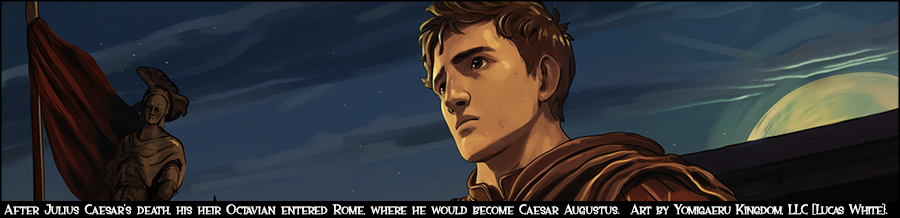
He made no parade of his coming. So anxious was he not to attract attention that, instead of landing at Brundisium, he put in at the obscure little port of Lupia, where he learned that Caesar had made him his principal heir and left him a gigantic fortune. He learned, too, of the extraordinary state of affairs at Rome, of the ascendancy of Antonius, and the radical weakness of the republican party and their leaders. Octavius was still a boy of eighteen, but though his years were few and his experience limited, he possessed the true instinct of statesmanship and boldly mapped out for himself the policy which he intended to pursue. As Caesar's heir, he would claim his patrimony in the ordinary legal and constitutional way. And as the very name of Caesar would prove a powerful political weapon to help his ambitions forward, he assumed the title of Gaius Julius Caesar Octavianus, and presented himself as a Caesar to the garrison of Brundisium. Many of his friends, sure that one so inexperienced as he could not combat successfully the perils and difficulties before him, prophesied that he would share the fate of Julius. But they little understood the character of him upon whom they urged their timid counsel. Octavian was a born intriguer and saw that there was room even for a late comer in the struggle.
In the first place, there was no natural head of the constitutional party. The ranks of the Optimates had been greatly thinned in the late Civil War, and many of its ablest leaders had been slain. The survivors were jealous of one another, and especially jealous of Cicero. Brutus was only the titular leader of the little knot of senators who had been privy to the conspiracy, and, since the Ides of March, he had given repeated proofs of weakness rather than of strength. There were few staunch, uncompromising republicans in the Senate, though there were many with definite republican leanings, who could occasionally be warmed into vigorous applause and a show of resolute action under the spell of Cicero's eloquence. But the majority of its members were anxious only to join the winning side and seem to have lent their active support to Cicero, to Antonius, and to Dolabella, according as each of these in turn appeared to be upon the crest of the wave. The events of the past month had also proved, beyond doubt, that the murder of Caesar was, on the whole, condemned by public opinion. Those who approved it were lukewarm and timid. Those who denounced it were hot for vengeance and carried swords. It had not excited any spontaneous outburst of enthusiasm in favor of the tyrannicides, for the people of Rome had never regarded Julius as a tyrant. He had not restricted their liberties, whatever blows he had administered to the oligarchs, and they were not disposed to make the quarrel of the Senate their own. Caesar had won victories. He had flattered their pride by extending the limits of the Republic. He had shown himself a chivalrous and magnanimous victor in his struggle with Pompeius. He had tolerated no proscription. He had proven himself a generous and bountiful patron. It was not alone the veteran soldiers of his grand army who lamented his death and cursed his murderers, and it is to this that must be ascribed the success with which Antonius had contrived to obtain the dominating position which he held when Octavian returned to Italy. He was consul, it is true, and he had the support of Lepidus, but it was as the friend of Caesar, the lieutenant of Caesar, and the inheritor of Caesar's policy that he was able to checkmate with such amazing ease the designs of the conspirators. Octavian, therefore, might reasonably expect that when he appeared as Julius's heir and adopted son he would attract to himself the support of a large section of the Caesarians, and would start with the good wishes of all who sincerely lamented the tragedy of the Ides of March.
His first act had been to assume the name of Caesar. Yet, while he deliberately chose this title, which the career of Julius had already made almost incompatible with the maintenance of a private station, he disavowed all political ambition, and gave out that his sole object was to secure his patrimony. He at once transmitted to the Senate and to Antonius his claim to his inheritance, and, suppressing the zeal of the veterans who flocked to join him, he made his way slowly towards Rome, accompanied only by a small retinue of personal friends. He traveled by a circuitous route, for we find him at Naples on April 18th, and he took the opportunity of calling upon Cicero in his neighboring villa at Puteoli. It was no chance visit that he then paid. Octavian was anxious to make friends and to disarm opposition in the ranks of the Optimates. He knew that Antonius would do his best to keep him out of his inheritance. If, therefore, he could secure the support, or even the neutrality, of Cicero, his position would be the stronger when he reached the capital.
The letters written by Cicero to Atticus during the first half of April show that the veteran statesman was depressed and morbidly anxious at the turn which events had taken. The triumph of Antonius worried him. "You see," he writes on April 11th, "after all, the tyrant's hangers-on in enjoyment of imperium; You see his armies and his veterans on our flank." Or, again, "The only result of our policy is that we stand in awe of the conquered party." The conspirators had quitted Rome and left the field to Antonius. Cicero's only consolation is the memory of the Ides of March. Again and again that ominous phrase appears in his correspondence. The present may be dark and the future desperate, but he turns for satisfaction to the past, and tries to console himself with the thought that he has witnessed the slaying of a tyrant. From Octavian he expects little danger. "Are the people flocking to see him?" he writes on the 11th. "Is there any suspicion that he is meditating a coup? For my own part, I don't expect it." A week later Balbus, who had visited Octavian, came to tell Cicero the result of the interview, and announced that Octavian intended to accept the inheritance. Cicero foresees from this only that there will be "a fine scrimmage with Antonius." He was then at Puteoli, where Balbus, Hirtius, and Pansa were staying with him as his guests. The adjoining villa was owned by Philippus, the stepfather of Octavian, and thither the young aspirant betook himself. "He is quite devoted to me," wrote Cicero on the 21st. There had been an interchange of visits, and Octavian had been careful to pay to Cicero the deference which Cicero loved. He had asked for counsel and advice. He had taken pains to conciliate his favor, and, when politics were mentioned, had kept a strict guard upon his tongue. Octavian must have known perfectly well how eagerly Cicero applauded the murder of Caesar, and how absolutely he had thrown in his lot with the conspirators. But at such a moment he would keep his ambitions well in the background, and speak only of his desire to obtain his rightful inheritance. Doubtless the young dissembler expressed to Cicero his entire acceptance of the amnesty passed by the Senate, and disavowed in the strongest terms any intention of seeking to avenge his uncle's death. We can imagine him solemnly protesting his overwhelming desire for peace and settled government and his readiness to support Cicero in his efforts to restore the reins of power to the Optimates. "Octavian treats me with great respect and friendliness," says Cicero on the 22nd, though he is not wholly convinced of the honesty of his intentions. The assumption of the hated name, Caesar, keeps his suspicions alive. He mistrusts the associates by whom Octavian is surrounded, for they are always threatening "Our Friends" with death. "How can he be a good citizen," he asks, "with such a name and such a following? The idea is impossible." And then he adds: "Octavian says the present state of things is intolerable. But what do you think when a boy like that goes to Rome, where even our liberators are not safe?" In brief, the result of the meeting between Octavian and Cicero at Puteoli was that Cicero, despite his suspicions, was flattered by the young man's attentions, and was encouraged to hope that he might influence him for good. Cicero was thoroughly convinced that Octavian's mission to Rome would be fruitless, that if he measured swords with Antonius he would inevitably fail, and that he was far too young and inexperienced to cope with his antagonists. He was, on the whole, well disposed towards him, and wished him no harm, but he made the fatal blunder of treating him, and thinking of him, as a boy. "Fancy," said he, "that boy going to Rome to match himself against grown men!"
Antonius began by making precisely the same blunder and scorned the notion that he had anything to fear. He was absent from Rome when Octavian turned his steps in the direction of the capital and leisurely proceeded north. Yet, even while he was in the neighborhood of Naples, Octavian had given striking proof of his boldness and resolution. He had pledged himself to defray the cost of the shows at the festival of the Parilia on April 21st, a festival in which Julius had always taken the keenest interest. This was his first step to conciliate the favor of the Roman citizens, and they admired equally the boldness of the giver and the magnificence of his entertainment. So when, after a few days' halt at Tarracina, Octavian entered the capital, he found the populace prepared to give him a warm welcome. He had awakened their curiosity. All classes were eager to see and note the bearing of Caesar's heir. And it was remarked that on the day of his entry there was a peculiarly radiant effulgence around the sun, from which men drew auguries favorable to the prospects of him who came as a private citizen, claiming a private citizen's rights. But there was a general feeling that the heir to Caesar's fortune would soon appear as a claimant for political power. His mother, Atia, and his stepfather, Philippus, did what they could to persuade him to drop the name of Caesar, but his unhesitating answer was that the dictator had thought him worthy to bear it, and that to shrink from accepting so glorious a name would be a confession of unworthiness. Consequently, he lost no time in appearing before the City Praetor, Gaius Antonius, and formally declared his intention of taking up his inheritance, as Caesar's first heir. It was also necessary for him to obtain the sanction of the people to his adoption by means of a lex curiata, and to this end he pleaded his cause in a speech wherein he eulogized his benefactor to the skies and took care to promise that he would pay the legacies which Caesar had left to every citizen. The speech was well received by the people, so well, indeed, that it brought the consul Antonius back to Rome in haste with the intention of silencing the new and dangerous rival who had appeared in his absence. A stormy interview took place in the consul's house. Octavian demanded his inheritance. Antonius replied that Caesar's money was not private but public treasure, and had been spent by him in the service of the State. He took credit to himself for having secured the ratification of Caesar's acts, warned Octavian that he was courting danger, and sought to divert him from the policy which he seemed determined to adopt. But Octavian was not to be browbeaten out of his rights, and when he left the presence of the consul his next step was to realize all the private estate of Caesar, borrow money from his friends and relatives, and raise a sum sufficient to pay the legacies which Caesar had bequeathed to the people. Not content with this, he provided the shows in honor of Caesar, as founder of the Temple of Venus the Ancestress, which Julius had built in fulfillment of a vow made on the morning of the Battle of Pharsalus.
Thus Octavian had not been a month in Rome before he had made a bold bid for popularity and had succeeded in attracting to himself the sympathies of the crowd. Profiting alike by the absence of the republican chiefs and by the unpopularity of Antonius, he boldly demanded that the golden throne and crown, which the Senate had decreed to Caesar, should be exhibited at the festival. This was vetoed by the tribunes in the service of Antonius, but the absence of these glittering tokens of power was more than compensated by the appearance in the heavens of a comet of unusual splendor, which Octavian and his friends immediately hailed as proof that Caesar was now admitted to the company of the gods. He ventured, therefore, to erect a statue to the new divinity in the Temple of Venus, the head being surmounted by a golden star, and in the midst of the excitement caused by this evident sign from heaven, the Senate was prevailed upon to decree that henceforward the name of the month Quintilis, which stood fifth in the Roman calendar, should be changed to that of Julius. If this was a triumph for the dead dictator, whose statues, not a month before, had been thrown down by Dolabella, it was an even greater triumph for Octavian, the dictator's heir, who now clearly stood forward as an aspirant for power.