The victors of Philippi speedily went their separate paths. Antonius, with a powerful army, undertook to reduce the East to submission, while Octavian returned to Italy to settle the veterans in their military colonies. Nor did they consult Lepidus in the new arrangements. While they had been campaigning in Macedonia, rumors of check and disaster had been current in Rome, and their colleague, the Consul, was strongly suspected of intriguing with Sextus Pompeius. Consequently, Antonius and Octavian assigned to themselves the supreme command in Gallia Narbonensis and the Spanish provinces, which had been given to Lepidus at the conference near Bononia, but it was agreed that if Lepidus cleared himself to Octavian's satisfaction he should be granted compensation elsewhere. Cisalpine Gaul was incorporated and placed on a footing of equality with the rest of Italy — an old scheme of Julius — and then, after dismissing from military service the soldiers who had served their full time, with the exception of eight thousand who volunteered to remain with the eagles, the Triumvirs parted — Antonius for the East, Octavian for the West. Antonius had chosen the easier and more congenial task. His march was absolutely unopposed. The provinces submitted one by one without a blow, and the conqueror imposed upon them his imperious will. On the cities which had resisted the republican chiefs and suffered heavily at their hands, he bestowed his lavish favors, but those which had espoused their cause only to be plundered he spoiled anew. Brutus and Cassius had wrung ten years tribute in advance from Asia. Antonius bluntly demanded a like contribution, cynically avowing that he was in pressing need of money and that the provincials might consider themselves fortunate that he asked no more. Continuing his triumphal march, he reached Cilicia. There he met the Queen of Egypt, who, with supreme confidence in the potency of her charms to captivate the pleasure-loving Antonius, had traveled to Tarsus in order to offer excuses and obtain forgiveness for her failure to send a fleet to the aid of the Triumviral forces. Cleopatra conquered with a glance and easily persuaded Antonius to return with her to Alexandria, where he spent the autumn and the winter of 41 B.C. among the riotous pleasures of the Egyptian capital, while his troops rusted with inactivity and he himself allowed his ambition to sleep.
Octavian had a much sterner task to face. To establish his control over Rome and the West was a vastly more difficult undertaking than to march at the head of a victorious army through the unresisting East. It must be carefully borne in mind — though the temptation to forget it is strong — that the prestige of the victory won at Philippi and the chief credit for the successful issue of a most hazardous campaign rested not with him but with Antonius. Octavian's share in the triumph had been small. The expedition against Sextus for the recovery of Sicily had been an inglorious fiasco, and his camp had been stormed by the soldiers of Brutus at the first Battle of Philippi. It was Antonius, therefore, who was regarded by the Roman world as the real victor and as the dominant personality of the Triumvirate, and Octavian only held the second place in popular estimation. Moreover, his continued ill-health flattered the hopes of his enemies that he would not live long to trouble them. The anxieties and privations of the recent campaign had not failed to aggravate his malady, and, on reaching Brundisium, his enfeebled constitution utterly broke down. He lay for some weeks between life and death, and a report that he had actually succumbed was widely believed. When he recovered, therefore, and made his way to Rome, he soon found himself confronted by a most formidable cabal.
So far as is known, no opposition had been offered by the republican admirals, Murcus and Ahenobarbus, to the return of Octavian and his legions across the Adriatic. They still kept the seas and attracted to themselves the broken remnants of the lost cause, but they allowed Octavian an unmolested passage — another striking proof of their incapacity to turn to practical advantage their naval supremacy. Octavian had first to deal with Lepidus, whose consulship had now expired. This clumsy soldier and still clumsier intriguer, who had owed his partnership in the Triumvirate not to his own abilities but to the accident that he had had so many legions under his command, was practically helpless in the absence of his patron and protector, Antonius; and when Octavian offered him the African provinces, in lieu of Gallia Narbonensis and the two Spains, Lepidus accepted without demur this curtailment of his dignities. Octavian had then to satisfy the time-expired troops. The soldiers demanded the Italian cities which had been selected for them before the opening of the campaign. The cities marked out for ruin claimed either that the whole of Italy should bear the burden, or that they should receive full compensation. Their inhabitants flocked in crowds to Rome to appeal to the sympathies of the Roman people and to the mercy of the young Triumvir. The former was easily won. The latter was hopeless. Octavian dared not offend or disappoint the legionaries. If they declared against him, his fall from power was certain to be even more rapid than had been his rise, and as there was no public money wherewith to compensate the victims, he was bound to carry through this piece of brutal injustice, even though he deplored its necessity. The sympathies of the Roman crowd were cheap and ineffectual. They dreaded the professional soldiers who were the real arbiters of the Roman State. The shrewder among them could see that by settling colonies of old soldiers in the Italian peninsula their rulers were practically creating a veteran reserve, upon which they might draw at any moment when they required an army. The cause of the Italian cities, therefore, was warmly espoused by all who had any quarrel with the Triumvirs and by all the supporters of the old regime.
Octavian, however, had as yet but few staunch friends. The older senators, who had held office under Julius and the Republic, preferred to attach themselves to the faction of Antonius, who seemed so much the stronger of the two. These now found their leader in Lucius Antonius, a brother of the Triumvir, who, with Servilius Isauricus, was consul for the year 41. Fulvia, the wife of Marcus Antonius, was also in Rome, actively engaged in watching the interests of her husband, and Manius, his procurator, was zealously devoted to his absent chief. Their first object was to delay the settlement of the military colonies until Antonius should return home, in order that Octavian might not reap all the credit for giving the veterans their reward. Then, when the soldiers pressed for immediate settlement, they induced Octavian to allow the colony leaders of Antonius' legionaries to be chosen from Antonius' own friends, and Fulvia and her children visited the camps, beseeching the soldiers not to forget the benefits which they owed to their old commander. The Italian cities were ruthlessly despoiled. Not alone in the south of Italy, but also in the Transpadane region, the rural proprietors were ejected from their farms without the slightest compensation, and to the seething discontent aroused by this measure of confiscation there was soon added a fresh source of trouble and danger. Rome and Italy were threatened with famine. Sextus Pompeius, still master of Sicily, had received numerous contingents of ships and men from the remnants of the republican army and navy. He had been joined by Murcus with two legions, five hundred archers, and eighty ships, and, in full command of the sea, he was now in a position to prevent any Spanish or African grain ships from entering the Tiber. His galleys ravaged the neighboring shore of Italy, and it was absolutely necessary for Octavian to undertake a campaign against him. But his hands were tied. Disturbances had broken out in all his provinces. He had been obliged to detach his lieutenant, Salvidienus, with six legions to march towards Spain, but these had found the passes of the Alps blocked against them by Asinius Pollio. And at this juncture Lucius, the consul, was marshaling his forces, bent on provoking another civil war.
The events of the next few months, which culminated in the siege and surrender of Perusia, form one of the most obscure passages in the period with which we are dealing. We know little of the character of Lucius Antonius and of the real motives which induced him to measure his strength against that of Octavian. Appian, indeed, tells us that he was a republican at heart, and was ill-affected towards the Triumvirate, which, as he saw, was not likely to come to an end when its appointed term of five years ran out. As consul he had raised six legions of infantry, and counted upon obtaining recruits in plenty from the dispossessed Italians. Yet the fact that he was working hand in glove with Fulvia and Manius warrants the suspicion that his protestations of regard for the Republic were only a blind. The truth was, that while Fulvia was anxious at any cost to rescue her husband from the clutches of Cleopatra, Lucius and Manius saw that Marcus Antonius was steadily losing his preeminence in the Triumvirate by lingering in the luxurious repose of the Egyptian capital. They tried, therefore, to force his hand and compel his return before Octavian should succeed in undermining his influence with the Antonian veterans in Italy. Octavian declared that he had no such object in view — that he was on the best of terms with his absent colleague, and that the aim of Lucius was to destroy the Triumvirate. The veterans, who were the real masters of the situation, sought to take the matter into their own hands. Consequently, a number of Octavian and Antonian officers met in consultation and drew up the terms of a compromise, which they endeavored to impose upon the rival leaders. They insisted that the troops of both should share equally in the division of any spoils which remained to be distributed, that two of Antonius' legions should serve with Octavian in the campaign against Sextus, that Salvidienus should be allowed a free passage across the Alps, and that Lucius should dismiss his bodyguard and administer his office fearlessly. The compromise was well meant, but entirely ineffectual. Lucius retired to Praeneste, where Fulvia, raging with jealousy and hate, worked her hardest to kindle the flame of war. Then the armies made a last attempt to bring about an understanding, and a conference was arranged to take place at Gabii, midway between Rome and Praeneste. But a chance encounter ensued between some scouts of Lucius and a party of horsemen belonging to Octavian, and Lucius, fearing treachery, broke off negotiations. War was immediately declared.
The rebellion assumed the most alarming dimensions. Octavian had only four legions under arms in Italy. One of these he promptly dispatched to Brundisium to garrison the port in case Marcus Antonius should appear on the scene, and to strengthen it against the attacks of Domitius Ahenobarbus, who was again patrolling the Adriatic with seventy ships. He hurriedly recalled Salvidienus and his six legions from their march towards Spain, and, leaving Lepidus in command of Rome with two legions, set himself once more to collect reinforcements from his faithful veterans. His adversaries, however, threatened him from all sides. Sextus, with his fleet, ravaged the coast, though he did not attempt a serious landing. Lucius had the active sympathies of the Italian population and what remained of the Optimates in Rome and the chief supporters of Marcus Antonius, Pollio, Ventidius, and Plancus, moved down from the north, with their respective contingents, at the heels of Salvidienus. The campaign opened with a success for the Antonian faction. Lucius suddenly appeared before Rome, and three of his cohorts entered the city clandestinely by night. Lepidus fled to the camp of Octavian, and Lucius became, for the moment, master of the capital. Summoning the people together, he delivered a harangue, in which he declared that he would punish Octavian and Lepidus for their lawless rule, and promised that his brother Marcus would resign his position in the Triumvirate, accept the consulship, and restore the old constitution. The people saluted him "imperator" on the spot, and, says Appian, immediately leaped to the conclusion that the unpopular government of the Triumvirs was at an end. But the able strategy of Agrippa, Octavian's right-hand man, speedily checkmated them. The forces of both sides were split up into scattered detachments, seeking to effect a junction. Salvidienus was marching south from Gaul to join Octavian, closely followed by the Antonians, and Lucius threw himself across his path to prevent his further progress. Agrippa thereupon seized Sutrium on the Cassian Way, in the rear of Lucius, and compelled him to draw aside. Agrippa and Salvidienus united their forces, while Lucius moved off to join Pollio and Ventidius. But the Antonian generals either marched too slowly or were too far distant, and Lucius retired to Perusia, near Lake Trasimene, which he strongly fortified against attack. In the meantime, Octavian pushed north, and succeeded in barring the further advance of Lucius' reinforcements. Pollio was driven to take refuge in Ravenna, Ventidius in Ariminium, and Plancus, who had destroyed one of Octavian's legions on the march, was brought to a standstill at Spoletium in Umbria. Octavian stationed containing forces in front of each of these three towns, and then returned with his main army to Perusia, where he closely invested the imprisoned garrison.
The siege lasted for some weeks. Lucius made desperate efforts to cut his way out, but was beaten back every time, and a half-hearted attempt on the part of Ventidius and Plancus to press through to his relief was checked by Agrippa and Salvidienus. Famine then began to make itself felt in Perusia, and Lucius came to the barbarous resolution of starving all the slaves within the town. They were not allowed to leave lest the enemy should learn the desperate straits to which he was reduced, and the miserable creatures, after a vain endeavor to prolong their wretched existence by eating grass and green leaves, perished in hundreds in the streets. At length, after making a final unsuccessful sortie, Lucius resolved upon surrender, and sent envoys to Octavian to ask for terms. Octavian replied that he would grant an amnesty to the veterans of his colleague, Marcus Antonius, but that all the rest must surrender at discretion. Lucius then boldly undertook to go in person as envoy to the victor's camp, where he was received with every mark of consideration. An unconditional surrender was agreed upon, but Octavian gave a free pardon to every soldier in the garrison, and enrolled them all in his own legions. The city, which he had intended to turn over to his troops for plunder, was set on fire by one of its citizens and burnt to the ground.
At a later time a story was current that, though Octavian spared Lucius and his troops, he caused three hundred of the leading men of Perusia to be slaughtered as a sacrifice to the shade of Julius, upon an altar erected for the purpose, on the anniversary of Caesar's murder. But Suetonius and Cassius Dio, while repeating the tale, are careful to refrain from vouching for its accuracy. Modern historians have been practically unanimous in rejecting it. The idea of human sacrifice was repugnant to the Roman mind, and it is impossible to believe that Octavian would have given his sanction to so senseless an act. He had never hesitated to remove enemies from his path when it had suited his policy. He had consented to the proscription, and he had shown himself more implacable than Antonius in dealing with the prisoners who fell into his hands at Philippi. But the wanton murder of three hundred dignitaries of a provincial town would have been a blundering piece of ferocity which, so far from benefiting him, must have aroused against him a feeling of universal odium. Probably the story grew out of the fact that Octavian did put to death certain of his personal enemies, whom he found in Perusia. Appian tells us the names of three, and adds that there were several others. And if their execution happened to take place, either by accident or design, on the Ides of March, the malignity of his enemies would naturally invent the detail that they were sacrificed at an altar, and would exaggerate the number of the slain.
With the surrender of Perusia, the rebellion immediately collapsed although the Antonian generals still commanded between them no fewer than thirteen legions and six thousand horse. Pollio allowed himself to be superseded in Cisalpine Gaul and took refuge with Domitius Ahenobarbus. Plancus abandoned his army and fled with Fulvia to Greece. Tiberius Claudius Nero, who had been the prime mover of the rising in Campania, joined Sextus Pompeius in Sicily, taking with him his wife, Livia, and his infant son, Tiberius. Asinius Pollio and Ventidius kept a few troops together and collected stores on the Adriatic coast in readiness for Antonius' return, but they were left unmolested by Octavian and Agrippa, who hurried north to Gaul to secure the six Antonian legions stationed there under the command of Calenus. The latter died before Octavian arrived, but his son, Fufius, handed them over without even a show of resistance. Substituting lieutenants whom he could trust for the Antonians who officered these legions, Octavian returned to Rome, and prepared for the war which Antonius was now threatening.
Antonius did not thank his friends for the way in which they had championed his interests. He seems to have given his supporters no hint of his intentions, and his lieutenants in Italy did not know what their chief desired. When his veterans sent delegates to him in Egypt, urging his immediate return, he detained them in Alexandria and vouchsafed no definite answer. Hence the otherwise inexplicable hesitation which marked the strategy of Ventidius, Pollio, and Plancus throughout the Perusian campaign, and hence, too, the absolute inactivity of Calenus in Gaul. It may be that Antonius considered his friends strong enough to crush Octavian without his help, and that he hoped to enjoy the profits of their exertions without sharing them himself. But it is even more probable that he was content to let matters drift. He did not desire a rupture with Octavian, or, at least, he did not want it then. Infatuated with Cleopatra, abandoning himself to the pleasures and excesses of the moment, he tarried slothfully in Egypt throughout the whole summer and winter and made no sign. His friends had stumbled into the quicksands. He left them to extricate themselves as best they could. Nor was it until the spring of the following year that he roused himself to fight for the position which was steadily slipping away from his grasp. He had gathered an army to repel an invasion of the Parthians into Syria, and had concentrated his forces at Tyre, when he decided that the moment had come to match his strength against that of Octavian. Leaving Ventidius — who had by this time rejoined him — to deal with the Parthians, he sailed with two hundred ships, furnished by Rhodes and Cyprus, to Athens, where he met Fulvia and Plancus, and prepared to invade Italy. Thus Octavian had again to confront a powerful alliance, for Antonius had come to terms with Domitius Ahenobarbus and Sextus Pompeius, the latter of whom promised to invade southern Italy. We do not know what communications passed between the two Triumvirs who now seemed bent upon fighting out their quarrel. Octavian, down to the outbreak of the Perusian War, had repeatedly declared that he was only carrying out the policy to which Antonius had given his sanction, and that there was a perfect understanding between them. But when Lucius and Fulvia appealed to arms, a rupture was inevitable, and when Octavian crushed the Antonian faction he took care to transfer as many of the Antonian legions as he could to his own standard. His march north to Gaul — which was Antonius' own province — and his dismissal of the Antonian officers from the legions of Calenus amounted to an open declaration of war, which Antonius could not overlook unless he was prepared to surrender his place in the Triumvirate. Antonius, therefore, landed part of his army near Brundisium and laid siege to the garrison, while Sextus Pompeius appeared before Thurii and Consentia.
But though the Triumvirs were hastening to settle their differences by the sword, their soldiers shrank from the conflict. The veteran legions of the rival commanders, old comrades-in-arms in the wars of Julius and the campaign of Philippi, insisted that their generals should come to terms. They found the requisite intermediary in the person of Cocceius Nerva, a mutual friend of both Octavian and Antonius, and an armistice was arranged pending the conclusion of a definite treaty. Antonius ordered Sextus Pompeius to quit Italy and retire to Sicily, and dismissed Domitius Ahenobarbus with the governorship of Bithynia; while the army of Octavian appointed a committee of officers to negotiate a peace. Cocceius was added to their number as one acceptable to both sides. Pollio was given a place in their councils as the representative of Antonius, and Maecenas as the representative of Octavian. They agreed that there should be amnesty for the past and friendship for the future, and, as the implacable Fulvia had just died at Sicyon and Octavian's sister had recently lost her husband, Marcellus, they determined that Antonius should marry Octavia and thus strengthen the ties of alliance. The rivals accepted with a good grace the terms thus imposed upon them by their troops, and their plenipotentiaries drew up the Treaty of Brundisium, whereby a fresh partition of the whole Roman world was made. It was now decided that the boundary line should be fixed at Scodra (the modern Scutari) in Illyria, that all provinces and islands east of that line should belong to Antonius and that all to the west should acknowledge the supremacy and be under the administration of Octavian. Lepidus, who at the conclusion of the Perusian war had been sent by Octavian to Africa with six untrustworthy legions, was again given no voice in this redistribution of power, but was allowed to retain the provinces assigned to him by Octavian. It was further agreed that both Octavian and Antonius should raise recruits in Italy in equal numbers, that Octavian should prosecute the war against Sextus Pompeius, unless they came to some arrangement, and that Antonius should resume his campaign against the Parthians. Such were the terms of the instrument known as the Treaty of Brundisium. As a further proof of goodwill, Antonius put to death his procurator Manius, who had served his master with too indiscreet a zeal, and disclosed to his colleague the meditated treachery of his lieutenant, Salvidienus, who had purposed to desert to Antonius with the legions under his command. The two masters of the State then repaired to Rome, where they celebrated with unusual pomp the ill-starred union of Octavia with Antonius.
They had still, however, to deal with Sextus Pompeius, who, to revenge himself for the ignominious manner in which Antonius had broken off relations with him, now blockaded the whole western coast of Italy and reduced Rome to a state of famine. Antonius pressed upon his colleague the advisability of peace, but Octavian, exasperated by the loss of Sardinia, which Menodorus, the chief admiral of Pompeius, had again recaptured, refused to treat. He insisted upon war, and, to raise the funds requisite for the building of a fleet, an edict was published levying a poll tax upon all owners of slaves as well as a new legacy duty. A tumult followed in Rome, during which Octavian was stoned in endeavoring to address the people, but his soldiers easily quelled the rising. Yet the famine grew so serious that an accommodation with Sextus became a matter of urgent necessity. Octavian was obliged to yield. He had, in the previous year, divorced Clodia, the daughter of Fulvia, and married Scribonia, the sister of Libo, father-in-law of Sextus Pompeius, and it was through Libo that negotiations were now opened. Sextus' relatives in Rome, acting on the suggestion of the Triumvirs, wrote offering him a safe conduct, and his mother, Mucia, was also induced to intercede with her son. Eventually Sextus agreed to meet his rivals, and a conference was held at Misenum. Two platforms were erected on piles at some little distance from the shore. Octavian and Antonius occupied the one, Sextus and Libo the other, and negotiations were carried on across the water which flowed between. Sextus, at the first meeting, boldly demanded a place in the Triumvirate in the room of Lepidus and abruptly cut short the interview when this was refused him. The famine was so severe and Octavian and Antonius were so much at the mercy of the man who held the command of the sea that they were compelled to offer generous terms. In the end, the three principals renewed their conference upon the mole of Puteoli and there composed their differences. They agreed that war should immediately cease, that the blockade of Italy should be raised, and that Sextus should send to Rome the grain which had previously been exacted as tribute from the islands of which he now was master. He also undertook to clear the sea of pirates and no longer afford a refuge to fugitive slaves. In return for these concessions Octavian and Antonius promised to acknowledge the dominion of Sextus over Sicily, Corsica, and Sardinia, to concede Achaia and pay an indemnity of fifteen million drachmae, to admit his soldiers to a share of all gratuities out of the public funds, to allow him to canvass for the consulship in his absence, and to grant full amnesty to all exiles, except those who had been formally condemned to death for participation in the murder of Julius. The signing of the treaty was celebrated by a banquet on board the magnificent flagship of Sextus, during the course of which the treacherous Menas suggested to his chief that he should slip his moorings and carry off his rivals. "Would that Menas had done this without my knowledge!" was the characteristic reply. "False swearing may become a Menas but not a Pompeius." At the banquet, the infant son of Octavia by her first husband, Marcellus, was betrothed to the daughter of Sextus, and Octavian and Antonius repaired to Rome while Sextus returned to Sicily. Throughout their journey to the capital and in Rome itself the Triumvirs were greeted with rapturous enthusiasm. The whole peninsula rejoiced at the prospect of peace, and at its happy deliverance from intestine war. The people thought that at last they had reached the end of their troubles and would now be delivered from the conscription of their sons, from the arrogance of the soldiery, from the defection of their slaves, the pillage of their fields, the ruin of agriculture, and above all from the famine caused by the blockade of the Italian ports. Once more a cruel disillusionment awaited them. It was speedily found that the Treaty of Misenum was not worth the paper on which it had been written.
Octavian and Antonius passed a few weeks in Rome in outward amity. They created new senators almost daily from the ranks of their own partisans, and sent written orders to the people, when they met in their comitia, instructing them how to vote. And so completely were they masters of Rome that when Antonius quit the city he carried with him a senatus consultum, ratifying beforehand all the acts which he might commit until his return. Armed with this authority, he dispatched his lieutenants throughout the East to rule in his name and interest, and then spent the winter at Athens in the company of Octavia, attending the festivals of the Greeks and listening to the lectures of the philosophers. He exchanged his military cloak for the square-cut pallium and Attic shoe, and led the life of a private citizen with a taste for philosophy and culture — a startling contrast from the Antonius who twelve months before had been rioting in the debauchery of the court of Cleopatra. Then, in the following spring, he pushed forward his preparations for the Parthian war. Meanwhile, Octavian had visited the Gallic provinces and, on coming back to Rome, had found that trouble was once more brewing with Sextus Pompeius. The stipulations of the Treaty of Misenum had not been honorably kept on either side. Sextus complained that Achaia had not been handed over to him, and let loose his roving ruffians to infest the seas. The corn ships again failed to arrive. Rome was threatened with another famine. Octavian had only consented to the Treaty of Misenum under the pressure of necessity, and had doubtless intended to take the earliest opportunity of crushing this formidable rival who lay upon his flank. He began to intrigue with Menas, the Pompeian admiral, who was now governor of Corsica and Sardinia, brought down his warships from Ravenna, and collected an army at Brundisium and Puteoli. He also requested Antonius to come to his aid. But Antonius disapproved of the war. It mattered nothing to him that Sextus was a thorn in the side of Octavian — Sextus did not menace his half of the Roman world. Consequently, he wrote to his colleague, advising him not to violate the treaty, and threatened Menas with punishment as his own fugitive slave. But this discouragement did not deter Octavian from his purpose. Menas deserted to his standard, bringing with him three legions and a powerful squadron, and handed over Sardinia and Corsica to one of Octavian's lieutenants. Octavian welcomed him with great cordiality, and left him in command of the ships he had brought with him, subject only to the general control of his admiral, Calvisius. Collecting his fleet into two squadrons, he himself sailed for Sicily from Tarentum, while Calvisius and Menas sailed from the ports of Etruria. Sextus awaited in person the attack of Octavian at Messana, and sent Menecrates to confront Calvisius and Menas. The squadrons of the latter met near Cumae, and a stubborn engagement ensued, in which the Pompeian fleet gained a signal victory. But its admiral, Menecrates, was slain, and the second in command, instead of pressing home his advantage, sailed back to Sicily. Octavian, who had been waiting for Calvisius to join him before attacking Sextus, advanced immediately through the straits when he heard of the disaster at Cumae. Sextus darted out of the harbor at Messana to take him in rear, and forced a general action, compelling the Octavians to take up a position along the coast, where they were repeatedly charged by the enemy, and many of their vessels driven ashore. It was a day of disaster for Octavian, and on the morrow a storm completed the havoc, but with his usual supineness, Sextus failed to follow up the blow. Well satisfied with having driven off his antagonist, he returned to Syracuse in triumph, where he proclaimed himself the favorite son of Neptune, bedecked himself in a mantle of sea-green, and again waited for his enemy.
Octavian's double defeat had reduced his squadrons to a miserable plight. Less than half his ships had survived, and most of these were badly damaged. Yet, thanks to the incapacity of Sextus, he was enabled to convoy his crippled vessels in safety to the port of Vibo. As ever, he rose superior to the adversity which threatened to overwhelm him. The people, hard-pressed by famine, refused to pay their taxes, and clamored for peace with the ruler of the sea. Octavian withstood their entreaties, and clung stoutly to his policy. He sent his trusty counselor, Maecenas, to Antonius, to persuade him to lend him the ships of which he stood in need, resolved that if the mission failed, he would embark his legions upon transports and carry the war across into Sicily. But he was saved from the necessity of this dangerous expedient by the return of Maecenas, who had induced Antonius to promise his aid, and by the welcome news that his able lieutenant, Agrippa, had gained a splendid victory in Aquitania over the Iberians, quelled the disturbances in that turbulent region, and was ready to come south with his army. Octavian rewarded Agrippa with the consulship for the following year, and employed his brilliant talents in a direction which showed that he had at last grasped the truth that seapower can only be overcome by seapower. "The elephant cannot fight the whale." To conquer Sextus he needed not legions, but ships. He set himself, therefore, to build a navy and construct a powerful naval arsenal. The genius of Agrippa speedily evolved a scheme. He saw that the first thing needed was a convenient base from which a bold offensive might be taken against Sicily. His choice fell upon one of the recesses of the Bay of Naples, where lay two landlocked pools between Puteoli and the promontory of Misenum. The Lucrine Lake, as one of these was called, was only separated from the sea by a narrow belt of shingle, while Lake Avernus was a mile inland. Agrippa connected the two sheets of water with a canal, built a wall of solid masonry to protect the outer side of the Lucrine Lake, and dug a narrow channel to give access to the sea. A powerful mole and breakwater completed the work, to which was given the name of the Julian Haven, and within this sheltered position Octavian was able to build the ships of which he stood in need, practice his crews, and lay the firm foundations of naval power.
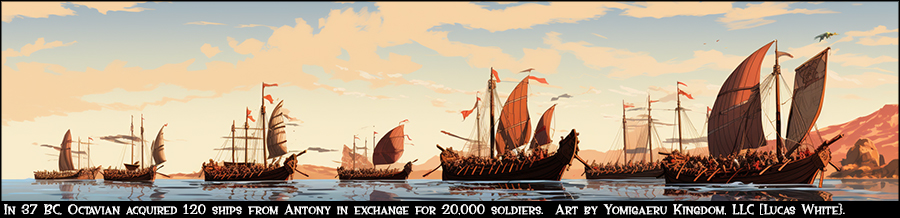
In the spring of 37 B.C., Antonius had set sail from Athens with 300 ships in fulfilment of his promise of assistance, but by this time Octavian had resolved not to try conclusions with Sextus until his own fleet was ready. Instead of welcoming Antonius, therefore, he made continued excuses for delay, and the relations between them became strained. Antonius found the expense of maintaining so many war vessels exceedingly burdensome, but, as he needed soldiers and was anxious to barter some of his ships for a part of Octavian's army, he sent his wife, Octavia, to Rome to use her influence with her brother. A meeting was arranged near Tarentum, at which the rival leaders once more temporarily composed their differences, and they parted — after renewing the Triumvirate for another term of five years — never to meet again until they encountered one another in desperate conflict off the coast of Actium. Antonius gave his colleague 120 ships in exchange for 20,000 Italian legionaries for the Parthian war. Octavia presented her brother with ten phaseli with triple banks of oars, which she had begged as a favor from her husband, and Octavian, not to be outdone in generosity, gave her in return a bodyguard of 1,000 picked troops to be selected by Antonius.