It was said that no one in Haiti slept so little or ate so fast as Christophe. The long years of campaigning had encouraged both habits. In the two months of April and May in that year of 1811 the legend of the King's haste grew to the proportions of an heroic myth. Christophe the soldier, the man of giant fearlessness, and Christophe the general, the leader who could move a regiment over the mountains with the swiftness of a parrot's flight, were well-known, well-loved figures. But administrator—that was a new facet of his brilliance. It made even his intimates blink.
Christophe kept himself closeted in the governor's mansion, now termed palace. All day, from dawn until long after the townspeople had boarded their shacks against the chill night air, members of the Council, generals and magistrates who had ridden in from the country, lounged on the broad verandah; one by one were called into the King's office, and one by one came out, their shoulders a little farther back, their eyes a little brighter; proud, and a little puzzled. The King was planning his Kingdom.
On Sunday, June 2nd, they put a golden crown on his head and a jeweled scepter in his hand.
The coronation ceremony was held in the cathedral at the Cap—a cathedral that had risen in two months from a smoke-blackened pile of stones and rotted beams on the Place d'Armes, the central square of the town. Every mason and carpenter and plasterer in the north of Haiti had assembled by royal command. They had been supplied with a company of unskilled helpers and instructed to rear the finest edifice the island had ever seen. When completed the height of the transept was 80 feet and the wall surrounded a nave that measured 250 feet on a side. There was a steeple with a place for a clock and chimes. The main altar and the lesser ones along the walls were covered with gaudy, brocaded cloth, and above them in niches stood freshpainted plaster Virgins and Christs and saints. There was a great hole at the eastern end open to the sky, for the rich stained glass window His Majesty had ordered from abroad had not yet arrived.
A French Catholic priest officiated. His name was Corneille Brelle and his office was that of chaplain to King Henry. Christophe had proclaimed Catholicism the official religion of the state and his first act as monarch had been to build the most pretentious church ever raised in Haiti to the honor of God and Rome. What less could Père Corneille do than play his role with good grace—even though he knew quite well that Henry scorned his church and called his God a thing of sawdust to be dangled before the frightened eyes of slaves.
Corneille Brelle, a tall, lean, sallow Frenchman, too dry and cold a man even to sweat with natural ease beneath his cassock, was ambitious. In the name of God he invested Henry with the power and name of King.
Four princes, eight dukes, twenty-two counts, thirty-seven barons, and forty chevaliers attended the ceremony. They comprised the hereditary nobility of Haiti, a black aristocracy just one month old, created by royal order. Henry, who knew his people, had rewarded his friends.
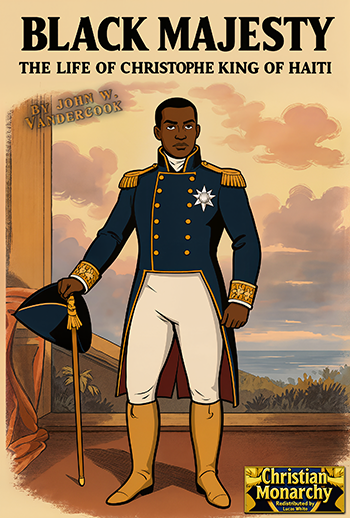
That night the shabby city of Cap Henry was illumined by flaring torches and a grand banquet was given at the palace. By Christophe's special order no social distinctions of any kind were made. Gaping peasants, their black skins shining from prolonged scrubbing, danced with negro duchesses and the ladies of mulatto barons. Carpenters and artisans in starched white shirts and trousers trod barefoot on the polished boots of generals. A smattering of English and American traders mingled in elaborate good fellowship with the greatest and the least in the realm. And above them on a dais sat King Henry, garbed in a new state uniform. His legs were encased in white silk stockings and his feet were in high-heeled patent-leather pumps. A peacock-blue jacket embroidered in gold was buttoned up to his throat and tight across the upper part of his broad chest. Beneath it appeared a quilted satin vest and on his shoulders were golden epaulettes. Bonaparte himself was never appareled more beautifully or more correctly.
Every eye in the great crowd of dancers turned adoringly to his face and saw the smile that hung on his heavy mouth. The Queen, Marie-Louise, the daughter of Christophe's former owner, Coidovic the innkeeper, sat beside him. She looked at him and saw his mouth suddenly grow hard.
A new-made baron, a big black fellow who had distinguished himself in the last battle against Rochambeau, had cleared a little space in the middle of the ballroom floor and was mincing in the minuet in elaborate imitation of the Emperor Dessalines. One clumsy foot caught behind the calf of the other leg and he sprawled full length on the floor. The crowd clapped its hands and shouted with laughter, while the baron, not troubling to get up, stretched out and shouted joyfully with them. Queerly, the splendid ballroom seemed to fade away, the rich uniforms give way to rags. Before the King's mind passed an old picture—of slaves dancing by fitful firelight in the clay compound yard. The music had not stopped, but the bellow of the sweating mob almost drowned it. It was an empty, echoing, foolish sound. Christophe's hands clenched so the knuckles showed white.
"Antoine!" he called.
The baron staggered to his feet and, accompanied by the heavy breathlessness of the quickly silent crowd, reeled uncertainly to the foot of Christophe's throne. He saluted with subtle impertinence.
Christophe spoke so low the disappointed dancers could hear nothing. "Antoine, you are appointed captain of the garrison at Thomasico. You will start to-night. Perhaps you had best go now and get ready."
The baron, immediately sober, brought his right hand to his clumsy forehead in a slow salute. Thomasico, he knew, was a tiny, dirty border hamlet at the farthest limit of the kingdom. His face grew sullen. The thick eyelids dropped over his eyes. Christophe's right hand went out and grasped the baron's wrist so tight he winced with pain. "Antoine, give my regards to our friend Pétion," he said.
The baron turned and strode from the room. With confused haste the couples nearest the throne resumed their dancing.
To the queen, Christophe whispered, "Marie, so much to do and so little time." And Vastey, who stood at his left side, overheard and nodded grimly. It was plain the King had sent a volunteer to join his enemies.
All that week and until midnight of the following Sunday the festivities continued.
In August of the same year work was begun on King Henry's Palace of Sans Souci, and in September, 1812, it was finished.
Milot, where it was built, is a little peasant town twenty miles inland from the bay. A wide, flat valley runs between ever-lessening hills straight down to the city, so that if one climbs a bit up the slope of the precipitous, magnificent mountains that lift up just behind Milot, one commands a view of the Plaine du Nord, of the distant city, and of the harbor and the ocean beyond. It is an imperial picture in green and blue and gold, softened by the pale mists the tropic sun steams from fertile earth. There, against the hill, the King put his palace.
When completed Sans Souci was the finest mansion in the New World. It rose four storeys above the highest terrace and was built of bricks plastered over with yellow stucco. The roof was of red tile. A mountain stream was conducted under the floors of the great halls of state on the main floor to keep them cool, and the water then ran out from the keystone of a marble arch, dropped twenty feet over a bright blue wall, and rippled away through channels painted a rich Pompeian red. A grand stairway, flanked at intervals by square stone sentry boxes, led to an exceptionally large open terrace at the western end of the palace. There were banquet halls, an audience chamber, the private rooms of the King, the Queen, the young Prince Royal, and Christophe's two daughters, the Princesses Améthiste and Athénaire, besides quarters for their people. Nearby were constructed an arsenal, a royal chapel, a presbytery, special barracks for the palace guard, a storehouse, a completely equipped printing shop, a stable, a carriage-repair shop, offices, and a formal garden where the favorite fruits and flowers of Their Majesties were planted. Everything was on a scale of grandeur never before or since equaled in the West Indies.
The rooms were paved with marble and paneled with polished hardwoods. Paintings, tapestries, many mirrors, furniture, and even a fine library were brought from Europe to make Sans Souci a truly splendid monument to a black man's wealth and taste and interests.
While the building was going on and until the last painting was hung in its proper place on the throne-room wall, Henry stayed at Milot, except when imperative business of state necessitated his riding to the Cap or over the hills to a distant town.
In a dusty uniform he directed the workmen and soldiers who were fulfilling his dream. Sometimes he would himself take a mason's trowel and work on the rising walls, remembering the trade taught him long ago when he was a slave boy on the far-away Caribbean isle.
And as he strode amid the confusion and the clatter of the building, tall young Dupuy and violent little Pompée Valentin Vastey, both barons now, kept near him and discussed the letters they would write for him.
The only contact they had with the outside world was through correspondence. Commercial and diplomatic agencies had to be established in England and the United States. Every mirror, chair, book, and tapestry had to be ordered by letter. Often in intervals of the work, while he ate and while others slept, Christophe dictated as many as a hundred epistles a day and signed each with his name.
At last Sans Souci was finished and the King and his court moved in. There were horses in the royal stable, and embossed and gilded harness, marked with the coat of arms of Haiti, hung on pegs along the whitewashed walls. A specially uniformed black regiment, called the Royal Dahomeys, was installed in the barracks. Thursday was set aside as the day Christophe received, first commons, then nobles. Every Thursday morning at ten he took his place on a throne in a chamber done in the gilded style of Louis XIV, and held public audience. For one hour his subjects could address him directly on any matter. Barefoot, half-naked black peasants, mustachioed, dignified little magistrates, their knee-boots dusty from riding in from remote districts, negro traders and artisans, officers and private soldiers, and occasionally a proud noble of the realm came with great and little grievances and elbowed one another vigorously to have first hearings. Christophe listened to them all and passed swift judgments that were in most cases uncannily fair. As the hour drew to a close, petitions were filed to be answered the following Thursday. Then a black page boy sounded a call on a trumpet hung with blue and gold tassels. The perspiring, noisy assembly suddenly grew quiet, and Christophe would adjust his cocked hat on his head and walk from the room, his long sword swinging to his stride.
On Thursdays at five, commoners were excluded and the aristocracy of the kingdom received. On fine days the reception was held on the terrace; when rain was falling, in one of the state chambers. But, rain or shine, the nobles came.
The court etiquette was strict. Every noble was required to appear in specially prescribed uniforms that were correct and immaculate down to the last button. With their consorts they sat primly in a semicircle facing a raised dais on which were the King and Queen and their attendants. "The footstool," said the official order, "is assigned to princes and princesses and dukes and duchesses. The folding chair to counts and countesses, barons and baronesses, chevaliers and their ladies."
The position of each folding chair and its corollary noble was assigned according to rank. The highest officials of the state were near the King. Besides Vastey and Dupuy, there was the Count of Limonade and, with unconscious minstrelsy, the Duke of Marmelade. Both titles were taken from the names of important townships that had been named long before by the facetious French.
M. the Count of Limonade, by name Prévost, was an elderly and highly educated mulatto who held the important portfolios of Minister of Foreign Affairs and Secretary of State. Richard, Duke of Marmelade, was a general, and governor of the city of Cap Henry. He, too, was a mulatto. On the outskirts of the group, where formality thinned off, were men still closer to the King: Dr. Duncan Stewart of Edinburgh, Henry's physician; Mr. M. J. Moor of London, mathematician and bon vivant; Señor Domingo Torres of Madrid; and the Archbishop of Haiti, Jean de Dieu Gonzales, distinguished chiefly for his atheism and his supreme skill in collecting tithes. These four were white men who out of curiosity, wanderlust, and a natural yearning for profit, had gravitated to Christophe's court. They had remained because they found a certain stimulus in being close to greatness.
Dr. Stewart, a tall, dour Scotsman, and Moor, his English opposite, had become the intimates of Christophe.
They often made excuses for not appearing at the Thursday afternoon receptions, and Christophe sometimes acquiesced. But anything short of death offered by a black noble as an excuse for non-attendance, drew down upon the delinquent the King's furious anger—a thing Haiti was learning to dread.
"If the French should come . . ." little Vastey was always whispering. . . . "They think all black men are undignified."
The King on Thursday afternoons would look with brooding loneliness into the faces of the men and women near him. Most of them were black. Nearly all had been born, as he had, on some mud floor where a tired slave woman lay and brought forth her young in lonely pain like some wild beast. "Monsieur le Duc . . . Madame la Comtesse," the droning voice of the Master of Ceremonies would say—and a folding chair would creak uncomfortably and a sooty face would work with the strain of some stiffly phrased reply. . . . "So much to do, and so little time."