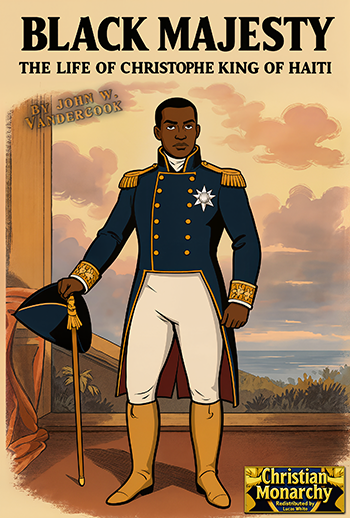
The gentlemen of the Provincial Assembly who had so anxiously watched the gray-brown faces of the freedmen the afternoon of the execution differed as to what they found there. Some discussed the question at the Crown Hotel that evening, gesticulated, and swore between loose lips wet with a fury of contempt. Their sallow faces grew hard and lined with a restless, unadmitted fear. Perhaps young Christophe's long-fingered hands gripped the tiny tray he carried with a tighter grasp than usual, but beyond that he showed no sign of hearing. The belief that negroes were things far short of human was by no means insincere. The blacks, who were present in some capacity at every private and public council, found this extremely useful.
The politicians of France resented the fashion in which their rulings had been set aside. Soon an order came giving to the free mulattoes the right of seats in the Provincial Assembly. It was a move scarcely aimed to strengthen the allegiance of the aristocrats who owned the sugar lands. Two regiments were sent from home to assist the new colonial governor to make a stand against the rebellion of the planters. But the soldiers deserted to the royalist camp and the governor was forced to leave the capital, Port au Prince, for the greater security of Cap Francois. The mulattoes in the south and in the west immediately organized and gathered by torchlight on the estates of rich affranchis. And in the hills behind Port au Prince, on remote plantations on the desert plains in the west, and in the distant communes of the north, scattered handfuls of slaves began to arm themselves with billhooks and cane knives, to fire and murder and chant the new cry of freedom. A very powder-barrel of a colony: the whites against France, the mulattoes against the whites, and the sullen, full-mouthed, hating blacks against the world. .. .
The black conspirators were most active in the north. Hardly an atelier in the extent of the great Plaine du Nord behind Cap Francois but had some self-appointed leader to whom the slaves looked for deliverance. All the plotting took place in secret, for the memory of the fate of Ogé and Chavannes had not died out. But while the whites, even though events had warned them to be preternaturally watchful, saw nothing, heard nothing, and scarcely found excuse for suspicion, an army and a complete organization came into existence in their back yards, in their kitchens, and in the sleepy, sweltering cane fields.
A code language, brought from Africa by the first slaves and nourished for two centuries, carried news to every black who had given evidence to the leaders that he might be trusted. Songs that had grown commonplace on the plantations carried new refrains which the careless ears of the whites could not detect. A phrase, an intonation in the melody, sung by a solitary herdsman or a black watchman at a sugar mill; a trick of the drum beat when the field workers gathered at the week's end for a dance under the watchful auspices of the estate foreman; a whisper; a tiny gesture—all served their purpose.
A negro leader named Boukmann, seeking something to bring his still fearful people to the sticking point, gave word that the King of France had proclaimed three holidays each week and put an end to whipping with the cat-o'-nine-tails—that their masters refused to obey. The blacks believed, but could not forget Ogé and Chavannes. They, too, had acted on the authority of that same King of France. In desperation the same leader added that a huge army was that same hour bound overseas from France to help them punish the disobedience of the planters. The excited talk in the compounds and the fields grew to a subdued bedlam at the delightful prospect—but still those who were to be responsible for giving the signal for open revolt kept silent, doubting what reliance could be placed in courage born of so illegitimate an ancestry of lies. On the night of August 14th Boukmann called a conclave of the leaders. They met, nearly two hundred of them, each one of whom had crept away under the cover of dark from a different plantation, in a dense bit of forest called Bois Caiman—the Alligator Wood —on a plantation in the Plaine du Nord.
Boukmann had set the stage. A half dozen torches stuck in the earth illumined with dancing flares of light a floor of pounded earth at the foot of a buttressed tree. Dark forms that emerged from the deeper darkness found places and crouched without a word, their eyes on the face of the leader. Without confusion, scarcely with outward evidence of the passion that made the fleshy lips in the crouching ring of men grow hard, they completed their arrangements down to the last meticulous detail, even the hour when the signal for the destruction of the whites should sound.
Then, when the talk was almost over, a thunderstorm massed up and obscured the remote starlight above the leaky roof of the jungle. Rain came down in a deluge, dousing all but a few carefully tended torches. Thunder muttered down the rain-drenched valleys. Sudden floods of lightning silvered the mountain peaks—and, as if born of the darkness and the storm, a giant negress appeared in the midst of the crowded open space. A long knife gleamed wet in her upraised right hand, her naked body was streaked with rain.
Slowly she began to sway in the movements of a dance regulated by some unheard rhythm within herself. It was a rhythm recognizable to all as one of the secret, unforgotten things of Africa treasured through the years of slavery. She sang a song, a song of the snake-gods, of the great, immortal lovers of the black man, his old-time friends who dwelt in storm and sky and woods and now stood ready to help or hurt, to be won by courage, to be appeased with blood. As her voice rose to a screaming moan, a tusked boar ran headlong, blinded and confused, into the clearing. With a movement so sudden the staring eyes around could scarcely discern it, the priestess flashed her knife down. The boar, with a squeal, slashed open from throat to groin, rolled over dead. In a bowl lifted quickly to her the woman caught the warm blood. With appropriate incantations she handed it round the inner ring of men. Each drank and, as his lips touched the blood, swore by the name of Papaloi, the snake-god of Africa, that he would give his life, if need be, to the cause of black rebellion. Boukmann was a high priest of voodoo, known and feared throughout the Plaine du Nord... . Toussaint, famous for his Roman Catholic piety, drank with the rest.
Eight days later, at ten o'clock in the evening of the 22d of August, 1793, a tomtom drum on Turpin plantation, Boukmann's home, suddenly broke the peace of the starlit tropic night. It carried a new, wildly lifting melody. Across the valley another took it up, then another farther on, and in an instant two hundred hidden drums on as many plantations were beating out the tune. Two thousand square miles of the rich farmlands of Saint Domingue throbbed with a foreboding, spreading mood. In two hundred great houses set back among the mango trees, whites came suddenly awake. Before the night was over the stars were extinguished by the glare from a hundred fires. An exact historian states that during the week which followed six hundred coffee plantations and two hundred sugar refineries were given to the flames. An incalculable number of whites were dragged from hiding and slaughtered in the most frightful fashions the slaves could conceive—or recall from their own extensive experience in torture.
For eight days bands of slaves held a carnival of revenge—and were then defeated at the gate of Cap Francois. Boukmann was taken and his head impaled on a pole.
Toussaint, who succeeded Boukmann as leader of the blacks, sought an honorable peace for the rebellious negroes who still hid in the dense forests on the mountain slopes. He failed chiefly because there was now no stable government with which he could treat.
Three commissioners equipped with complete powers reached Saint Domingue. The King of France dropped his head into a basket. The colored men allied themselves definitely with the cause of the Republic of France, and Christophe, the inn servant, married the fifteen-year-old daughter of his employer, the negro Coidovic. Her name was Marie Louise.
In the same year, 1793, France went to war with Spain and England. Toussaint and the other leaders of Boukmann's rebellion crossed over into the Spanish half of the island and became generals in the Spanish army. They soon began to overrun the French territory they had so lately left as runaway slaves. And the whites, to complete the treason, appealed to England to invade Saint Domingue and protect them from the mulatto army that was warring with such conspicuous relish in behalf of the Republic. The civil commissioners, seeking a desperate cure-all, granted general freedom to all slaves in Saint Domingue.
From the maelstrom of events the least expected and the solitary thing of deep importance emerged—the freedom of the blacks. The whites and mulattoes had followed their courses in pursuit of opposite goals; the history of Europe had turned a somersault while the blacks had continued their inarticulate fight. But no one had particularly heeded them. Few thought much was seriously amiss that could not be remedied by eventual swift punishments. But an army faithful to Republican France was badly wanted and granting freedom to the slaves seemed the only sure way of recruiting it.
The beginning of the year 1794 found Saint Domingue in a sorry state. The Spanish armies under Toussaint and the other negro leaders held almost all the northern and eastern regions of the colony. The English, who had gladly come to the assistance of the rebel white colonists, held Port au Prince, most of the western seaboard, and important positions at the extremities of the northern and southern peninsulas. The commissioners who had granted universal freedom were home in Paris, explaining their extraordinary move to a government little interested in anything that transpired more than a league or two from the banks of the Seine.
A French Republican general was attempting to expel both invaders, realizing his efforts were doomed to failure. . . . Then Toussaint made up his mind that the aim of his long life's ambition, negro freedom, could best be achieved by alliance with the French, and turned a sudden right-about. He quit Spain for France, and began to fight back over the same territory he had so lately won. In a campaign scarcely equaled for its vigor in all military history he led his ragged legions of ex-slaves over the towering mountain ranges of the north, stormed a dozen towns, and raised the tricolor over each, proclaiming, as he advanced, the universal emancipation of the blacks.
Toussaint had no desire for the political independence of Saint Domingue. That dream had not yet been born. Toussaint spoke French as his mother tongue. All his education had come out of books written by Frenchmen. He hated the cruel aristocrats who had made slavery a horror on the island. He hated the planter who had buried nine black men up to their necks in the earth and then invited his friends to a game of bowls, with iron cannon shot for balls. But with devoted fidelity he loved the master who had been kind to him and he loved the men of Paris who had proclaimed the glorious creed of liberty, equality, fraternity. It was unnatural for him to fight for Spain, the enemy of his own country. It was natural for him to return to the tricolor cause when it had given proof in practice of its promises for human brotherhood. It was easy, too, for "the Physician," the beloved and admired of all the slaves who knew him, to transfer overnight the allegiance of his army.
General Toussaint, with the astonished eyes of the world upon him, came with his army within a few hours of Cap Francois, one of the few towns in the north he had not taken for Spain. He was received, by all but a handful of disgruntled royalists, as a deliverer. Regiments of black recruits flocked to his standard. They were glad to quit the work of the fields and sugar mills and were avid for a chance to fight the battles of the mother country that at last had declared against the vain, cruel gentlemen who for generations had compelled fourteen hours of work each blazing tropic day.
Among the first of the volunteers was Henry Christophe, the inn servant. He had watched, learned much, and waited long. Now at last the wheel of black men's fortunes had spun and paused to his liking. Toussaint, now dubbed L'Ouverture because of the almost uncanny gift of "opening" everything before the avalanche of his military operations, had known young Christophe and marked him as a likely man. Henry, who was twenty-seven, received the rank of sergeant and was put over a small band of men. In the swift rush and shift of fortunes which filled the ensuing years Christophe disappears, to emerge seven years later as a general second only to the great Toussaint himself in rank, governor of the city and region of Cap Francois, and owner, so they say, of the richest, most superbly furnished mansion in the town... . In those seven years Henry Christophe had learned to write his surname. When he became king he learned to sign the "Henry," too.