In seven years the slaves of the fields had created a kingdom. Toussaint, the coachman, was Governor-General and ruled over the whole island. No one before him had succeeded in uniting both the Spanish and French settlements and the all but impassable mountain ranges under a single rule. Never in the history of the world has as barren a human field yielded in a little time so marvelous a flowering of greatness.
The slaves had come from a thousand hidden towns and many hundred jungle tribes of Africa.
They had been brought in chains to a new and hateful world. Here they were barred from communication with their fellows until all picked up the awkward patois French that became the common tongue of the plantations. Through two long centuries they had been degraded by cruelty, weariness, and homesickness almost below the level of humanity. Yet, when the hour struck, they were ready and leaders were found most strangely touched with genius.
There was Toussaint, who conquered the armies of Spain, drove the English into the sea, and rose through every military honor till at last he had won for himself the unprecedented rank of Governor-General of Saint Domingue for life, with the privilege of choosing his successor; Jean-Jacques Dessalines, the African slave of a black, ferocious, unlettered, who achieved the rank of a general in the proud army of France and became governor of a province; Henry Christophe, black slave boy and stable hand who climbed with meteoric rapidity from the rank of sergeant to that of general and military governor of Cap Francois; Alexandre Sabes Pétion, the bastard son of a white French artist and a mulatto woman, scholar, soldier, painter, and lover of his people And there were twenty others of almost equal prominence who rose from the ranks of the mob-like army of the blacks.
For seven years of continuous, confusing, costly war these men had led their ragged armies against Spain, against England, and, unhappily, often against one another—while in France a pale, vain little Corsican ran like a fire over Europe before the tornado of his own ambition.
In the first year of the nineteenth century France under the First Consulate of Bonaparte found herself at peace for the first time in a decade. The armies that had conquered Kurope were idle. Insatiate Bonaparte was faced with the realization that rich colonies must be found for the wealth and energies of France if that wealth and energy were to continue. Saint Domingue, once the most important overseas resource of Europe, had slipped somehow through his fingers. The great sun-warmed plains and hillsides that once had sent an unending procession of merchant ships laden with sugar and coffee to all the ports of Europe were now barren tracts of ashes and rank weeds, cultivated sparsely by black men who sent their produce to the United States and England And over all these blacks reigned a little negro who had won powers which within his lesser scope surpassed that of Napoleon himself.
There were many men in Paris who formerly had been planters of Saint Domingue. Now peace had come and profitable occupations were scarce, they thought pensively of the wealth and ease they so unwillingly had left behind. Men were found who were close to the First Consul. They poured into his ears continual tales of Toussaint—who had first made himself dictator and then sent an envoy to Napoleon to tell him of the change in the government of Saint Domingue, without a word of "by your leave."
Soon Napoleon gave orders that six of his greatest shipyards should set to work at once to prepare the greatest fleet France in all her history had ever dispatched across a sea. Eightysix ships of war were to carry 22,000 soldiers—the pick of the army that had conquered Italy and Austria. Surely Christophe, Toussaint, and Dessalines, the three slaves who long ago had watched another fleet of France in the roadstead of the Cap, must have sensed the flattery, found substance for wonder and pride and a strong faith in their great destinies.
Napoleon, because he had black men to deal with, and therefore fools, he thought, sought out two young sons of Toussaint's who were in Paris. He found time to have them come to his palace, where he talked with them and their tutor, a white Frenchman named Coisnon. The two young negroes had been at school in France for six years and they knew little of what had happened in Saint Domingue. The flattery of an audience with the greatest man in Europe and his courtesy toward them made a profound impression upon the two young negroes. He told them deliberate, foolish lies to be repeated to Toussaint, of his intention to continue the freedom of the blacks and his wish that Toussaint understand the fleet came not to fight him, but to "cause the name of France to be respected among the enemies." Toussaint's sons embarked with the expedition when it sailed not long after, fired with a patriotic wish to show their father the error of his ways.
The expedition seemed to most of them a sort of happy aberration of the First Consul's to be enjoyed while it lasted, but surely not to be taken so seriously as the extent of the expedition indicated.
Charles Victor Emmanuel LeClere, Captain-General of the expedition, looked upon fortune as singularly kind. In a time of meteors, his whirl across the sky of Europe had been luminous second only to Napoleon himself. First a volunteer, then a captain, and soon a general, he had achieved great fame in Italy and won as prize Pauline, Napoleon's own sister.
In that winter of 1802, when the expedition sailed, LeClere was thirty and Pauline, who went with him, was only twenty-two. They had married five years before. LeClere wore splendid whiskers down his cheeks to add dignity to a youth the older soldiers found somehow offensive. Pauline, who was slender and beautiful and gay, was quite content to look her years. The world lay at their feet.
Bonaparte was surely destined to rule the world, and, just as surely, he could be depended upon to present some pleasant part of it to his friend and general and brother-in-law. Saint Domingue? No doubt a rather charming place. The flagship of the fleet was laden with tapestries and furniture and all the pleasant, rich accessories that went to make a palace worthy of relatives of the First Consul. As soon as these blacks could be induced to get back to work Napoleon would no doubt need a governor-general, though he had not announced what future plans he had in mind. Saint Domingue would serve well enough till an even more splendid corner of the world should want a ruler. If only those fellows hadn't painted such an exaggerated picture of Toussaint's strength! Two thousand picked men would have been so much less of a nuisance than twenty-two thousand.
On the morning of February 8, 1802, LeClere and the larger part of the fleet arrived in the open sea off Cap Francois. Three other divisions, each under a different general, were at the same time preparing to attack at other strategic points on the coast.
LeClerc, as soon as the great promontory at the western end of the bay was sighted, gave an order for the ships to come to rest in the open sea. Then he sent a young ensign named Lebrun to tell Christophe to prepare the town for his reception.
The small boat in which Lebrun approached the shore was hailed from a fortress on the extremity of the point. He made a landing on the narrow shale-strewn beach and was greeted by General Christophe, whose reserved dignity, it is said, quite overwhelmed the young Frenchman. As they mounted the steep slope to the fort Lebrun noticed that a whole battery of cannon had been placed on the highland overlooking the narrow entrance to the bay. Every soldier of the garrison carried an unlighted torch.
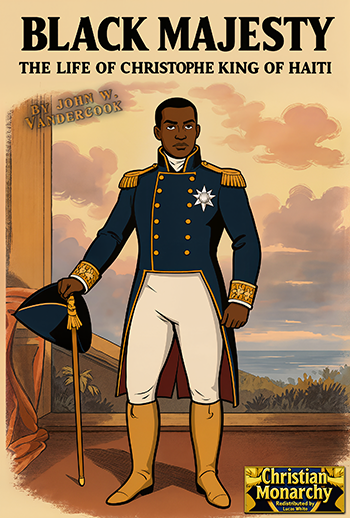
Christophe, magnificently garbed in the full-dress regalia of a General of France, received Lebrun with somber courtesy. In silence they drove through the city to the governor's palace. As they rode along Lebrun, as if by accident, let fall a packet of printed handbills that were picked up and quickly circulated through the crowd. This did not, as Lebrun hoped, escape the notice of Christophe.
Lebrun bore letters addressed to Toussaint. He refused to put them in Christophe's hands. He had no message for him, he said, except Captain-General LeClere's order to deliver the town at once. But he whispered to Christophe, "LeClere will cover you with honors if you will deliver the town before Toussaint comes!" It had been agreed in Paris that the black officers could be cheaply won.
Christophe drew himself up to his great height. The afternoon sunlight streaming through the palace windows glinted against the golden epaulettes upon his shoulders. His full, reverberant voice came so that all in the great hall could hear.
"You think me capable of betraying my trust?
Citizen, I am a soldier. Governor Toussaint is my chief. I will recognize no other authority until he has told me himself that France has properly replaced him. . . . You, Citizen, will spend the night with us and to-morrow I will return you to your General. I am dispatching messengers to Governor Toussaint. Until I have word from him you will keep your ships safe out of range of my cannon."
The young aide-de-camp went off the next morning to the flagship outside the harbor to tell the astonished officers that he had dined that night off plates of gold served by pages and that the great banquet hall of the ex-stable boy's palace was hung in draperies of brocaded silk. He reported that the mayor of the city, a negro named Télémaque, enthusiastically favored LeClere, that the 2,000 white residents of the city were ready to receive him with avid hospitality. Lebrun surprised them by saying that Cap Francois was such a city as no one dreamed to find so far from home, a city with wide streets, rich houses, a theater where the nightly play was well attended, and great levees at the Governor's palace commonplace. Pauline was delighted. The musicians, clowns, and players she had brought to save her from dullness were charmed at the thought of the salons that might be gathered, even here.
But LeClerc was impatient. He wrote:
I learn with indignation, Citizen-General, that you refuse to receive the squadron of the French army which I command, under the pretext that you have no order from the Governor-General. ... I avow it will distress me to have to count you among the rebels. I warn you that if to-day you have not delivered all the batteries of the coast, to-morrow at daybreak 15,000 men will be disembarked. . . . I hold you responsible.
General of the Army of Saint Domingue and Captain-General of the Colony LeClerc.
Christophe replied:
I have dispatched one of my aides to Governor L'Ouverture to inform him of your arrival. Until his reply reaches me I cannot permit you to disembark. If you have the force with which you threaten me, I shall offer you all the resistance which characterizes a general. If the chance of war favors you will only enter the city of the Cap when it has been reduced to ashes, and even upon the ashes still will I fight you. . . . As to the troops which you say you will disembark, I look upon them as so many cards which the least wind will blow down. . . . As to the loss of your esteem, General, I assure you I do not want it at the price you put upon it, if it must cause me to act contrary to my duty. I have the honor:
H. Christophe
The letter was dictated. But the bold signature at the bottom was scrawled by the black slave who could not read what he had caused to be written.
There was another exchange of letters, with no increase in diplomatic phrasing on either side. Two days later LeClere carried out his belated threat and landed his troops. But of the 800 splendid buildings that had composed the city, only 60 were standing. Christophe, too, had kept his word and burned the town. The tearful pleas of Mayor Télémaque, the petitions of the townspeople, the open threats of the 2,000 whites, and the desertion of a good number of the soldiers of his own regiment had not dissuaded him. Christophe never changed his mind. And, till the day he died, no one within sight of the fire of his hypnotic eyes or in sound of his imperial, booming voice ever dared to disobey him. He himself had lit the first torch. With his own hands he had put the flames to his own house, the richest on the island. With it he destroyed all the wealth he had accumulated during the period of Toussaint's ascendency, making himself homeless. But the flames that gutted his paneled walls and melted down his golden plate caught the town, blazed across a world, and gave challenge of war to Napoleon himself—Napoleon who had never known defeat.
When LeClerc landed, it is said that Pauline and her entertainers burst into unhappy tears at the sight of the ruined town. Henry watched them from a hidden eminence in the jungle-covered mountains behind the city. Then with a handful of soldiers he went through the hills to join Toussaint and plan a way to conquer.