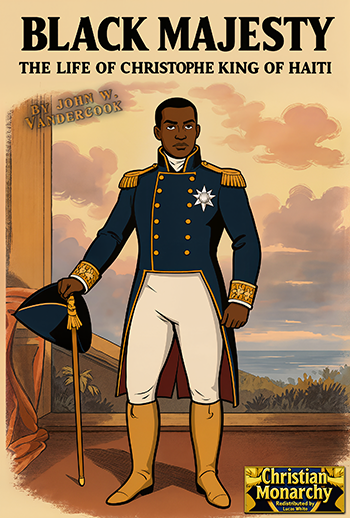
The news of the fall of Emperor Jean Jacques was brought by military messengers to where Henry Christophe governed the city and region of the Cap. His enemies say he smiled and made a quick French gesture with his mobile hands, as if to ring a curtain up on a part of the show in which he was at last to play the lead. His friends—and in that time they were in the majority—say he drove the dispatch bearers from him in a burst of fury, retired alone to a little chamber for a while, and when he joined his officers again, looked unseeing from a mask grown gray and old. Jean Jacques and he had been slaves together, both of them slaves of black men. Together they had seen the execution of Ogé and Chavannes, together grown to the stature of generals and masters of men. Christophe and the Tiger had been linked by too strange a destiny to sever with a gesture.
Whatever his first reaction to the news, on the same day Henry called his secretary and dictated a letter. It was addressed to the mulatto officer who had been chief conspirator against Jean Jacques. The tragic events which you write me of give me great pain. ... I have never, as you know, been dominated by pride or ambition. The happiness of my citizens has always been my one desire. It would only be with great misgiving that I would accept the great burden which the unanimous will of my brothers has placed on me in confiding to me the reins of government, were it not for the firm conviction that your light and counsel will always come to my aid in case of necessity.
I therefore accept the task which is as honorable as it is painful and difficult. Tell my sentiments to the army. ...
Henry had had opportunity to consider the faults of the Empire. He gave orders that a national representative assembly should be convened, and that it should draw up a republican constitution and appoint whomever it saw fit as ruler. He knew that 33 parishes in the north could be relied on to elect representatives unequivocally behind him. These would safely balance the 23 parishes in the south and west controlled by mulattoes none too fond, for social reasons, of full-blooded blacks.
But when the Assembly at last met, after an inexplicable and wasteful delay, the representatives from the north were astonished to find that the mulattoes of the south, headed by Pétion, had elected 41 representatives, a safe majority.
In an atmosphere of mutual distrust, they quarreled and debated, and at last, on December 27, 1806, after a nine-days' wrangle, produced a republican constitution and unanimously declared Henry Christophe President of Haiti—but for four years only. A senate would appoint the Cabinet. It, too, would make all laws and control the army.
During the months of waiting, Henry Christophe had ridden over half the tortuous trails and nearly all the roads of the north. A page boy had always accompanied him, carrying a brass telescope, once the property of a now dead captain of Napoleon's fleet.
When they came to eminences they stopped and through the lenses Christophe swept his eyes over the great plains, the hillsides, and the nestling whitewashed towns in the gorges. Wherever he looked there was the same drab spectacle. The fields were forests of bramble and weed, except where they were black from fire. Half the slopes had been raked and pitted by cannon balls and the towns were a confusion of broken mud walls and thatch that had wanted renewing for a decade. During the war times no one had farmed except to gather the cotton, coffee, sugar, plantains, and bananas that grew wild. Under the tyranny of Dessalines the cultivators, discouraged by the unhindered raids of the irregularly paid soldiery, had not thought it worth while to plant. Geometrically trenched fields, the smashing grind of macerators turning cane into sugar, these reminded them of the old days when white men and the hunger of the fertile land were masters. Now, were they not "free"? And what better thing was there to do with freedom than to sleep the drowsy days away, then dance through the night under the stare of the white moon?
The long-fingered negro hands that grasped the brass telescope grew white-knuckled with the intensity of his impatience. Soon, soon, he'd wipe the scorn off the face of France! Not a man but would be rich and happy. Not a meter of land but would be turned in furrows, not a grain loft empty or a mill not turning. The world must be taught by example that the despised "nigger" could take his place in the world.
Then the constitution came and proved to be a futile work of jealous yellow men who lacked the courage to recognize their need for a master. Christophe summoned his troops.
Swift orders were given. In his richest uniform of peacock blue, edged with scarlet and embroidered with gold, with a huge half-moon hat trimmed with a white ostrich feather on his head, he rode before them, down toward Port au Prince. Soldiers joined him all along the way.
He reached the city simultaneously with the arrival there of the mulatto army of the south.
Christophe attacked and was repulsed.
Two days later he issued an order for his army to right about and return to the north. The soldiers were to disarm and go to their homes.
Port au Prince, overcome by astonishment and delight, was left to its own resources. They had realized the city, except for a miracle, was doomed, in spite of their first successful resistance. But the miracle had occurred, a miracle born of a black man's vast impatience.
The army, with the same driving haste with which it had come, marched home and was disbanded. The men of the south, somewhat foolishly, picked up the shattered pieces of their pride and founded a republic.
Henry Christophe returned to his palace at Cap Haitien (the name of Cap Francois too had been changed). At his order the civil and military leaders came together to draw up a constitution. There was little wrangling, for they knew what he wanted.
On February 17, 1807, the new constitution became law.
Christophe was chief governor. They made him generalissimo of the land and sea forces of Haiti and they bestowed on him the privilege of choosing his own successor, stipulating the choice must be made from among the generals.
"The choice must be secret," the constitution said, "and contained in a packet hidden away which is to be opened by the Council of State solemnly assembled for that purpose. The President must take every necessary care to indicate to the Council of State where the packet is put away."
He was to select his own ministers and suggest laws to the Council, and he could, without appeal, veto any they made. But it was clear the Council would be most unlikely to experiment. Almost the only duty of that body was to furnish a strict and detailed annual accounting of the money they had spent.
Catholicism was declared the official religion of the state—but with complete toleration of all other sects. Divorce was forbidden. Fathers and mothers, under the new law, had no right to disinherit their children. Haiti would not interfere with the politics of any neighboring colony. Foreign business men were assured absolute protection. And the salary of Henry Christophe was put at what was the equivalent of $40,000 a year, to be paid out of a treasury which did not exist.
Christophe was forty. Because his life had been so crowded and because despair had so often dogged him he already looked upon himself as old and he was tortured by the sense of the little time he had. He had never read a book and he could write only half his name. The only association he had ever had with educated men was when he was a waiter at the Crown Hotel and was privileged to overhear the talk of drunken slave-owners and homesick soldiers of France. But he had known Toussaint L'Ouverture and he had watched Dessalines pitch down to disaster.
Haiti was bankrupt. Christophe sent letters to the United States and to the European powers offering opportunities for profitable trade. Haiti had no currency system, so he created one.
After the destruction of the plantations and the abolition of slavery, the black cultivators of Haiti had grown more and more dependent on wild produce. Their huts were made of mud and sticks and palm leaves. Food grew wild or with little urging. For utensils, bowls, spoons, and bottles, the blacks made use of the fruit of the gourd vine, dried in the sun, scraped clean of seeds, and then cut into the requisite shapes. If there was such a thing as an irreplaceable necessity in the careless life of the peasants, it was the gourd, Christophe mused. Gourds were useful, but they soon wore out.
Chief Christophe issued an arbitrary act which declared every green gourd in northern Haiti the property of the state. A new crop was just ripening and soldiers were sent to every commune to collect it. The peasants made no objection, Christophe was their master now and whatever he did was right.
Gourd vines grew over many garden walls. Others had flung a rank, concealing tangle over the ruins of houses burned by Boukmann's rebels sixteen years before. Another sort grew on prim, round-headed little trees. Without regard for quality or ownership, Christophe's messengers took them all and a great procession of laden burros and high-piled farm carts brought them into Cap Haitien. Before long 227,000 green gourds and calabashes were deposited in "The Treasury." Christophe put a value of twenty sous on each.
The coffee crop was almost ripe. When the cultivators brought the dried berries into the capital, Christophe bought them at the current market rate and paid out his gourds, which by this time the peasants needed badly. Then he resold the coffee to European merchants for gold. Before the year was out the state of Haiti had a metal currency of absolute stability in circulation. To this day the standard coin of Haiti is called the gourde.
Christophe got word of a secret correspondence being carried on between some Haitians and certain mulatto malcontents in Jamaica, England's island colony to the southwest. A feeble plan designed to foment a rebellion there against the British had been set on foot. Christophe sent soldiers to arrest the Haitian agitators, tried them himself, and sentenced them to the prison work gang. Then he took good care that the English should hear of what he had done.
England promptly entered into a commercial treaty with him and English merchants soon arrived to open trading stores in the Cap.
The outlook was favorable, but Pétion and his friends in Port au Prince had recovered from the shock of Christophe's triumphant march against them and had resolved to expand their territory.
The army of the Republic numbered nearly 10,000. As soon as Henry was safe at the Cap and his troops had partially disbanded, it sallied forth in leisurely fashion and occupied a number of towns at the rim of Christophe's dominion. Christophe marched against them and was victorious in a series of violent fights.
But the civil war continued for nearly five years. Christophe from the first had discarded any notion of extending his sway into districts not unanimously servile to him. But he was willing to accept a challenge. A violent personal animosity existed between the two leaders. Pétion, whose subjects were free from all restrictions, called Christophe a tyrant. In his speeches he was always careful to point the parallel between Dessalines and his successor. Both were absolute, black, and ignorant, and, he predicted, both would end in the same fashion. Christophe, for his part, took satisfaction in pointing out that the mulatto president had issued 4,000,000 worthless dollars, stamped out of tin, and that with the remark "all men are thieves" he had ceased all effort to stop the corruption of his ministers of state. But at last the wasteful conflict drew to an exhausted close. No peace was made. But hints were coming from the other side of the Atlantic that France was finding too much comfort in their quarrels. If Haiti was to build impregnably, it behooved her to quit tearing down and set at once to work.