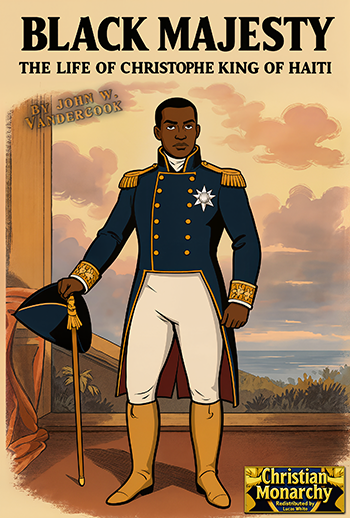
Cap-Haïtien is a town made listless by the sun. It sprawls along the edge of a shallow bay on the north coast of the island of Haiti 800 miles southeast of Florida. The streets are narrow and either swarming and noisy with negro men and women or utterly quiet but for the dull droning of flies in the gutters. Low houses flank the roads with not an inch to spare. Sometimes one comes upon a building freshly kalsomined rose-red, or yellow, or pale blue, but on most green mold has etched drab patterns in plaster rotted by long neglect.
Life for the blacks of the Cap is easy. The eternal warmth of summer, a few plantains, yams, loud laughter and the swift crackle of patois talk in the markets suffice for a barefoot citizenry.
Behind the city is a vast plain that lies between two mountain ranges. Mangrove and dwarf scrub forest make of it a desolate, warm wilderness, Along a muddy road eastward from the Cap there are huddled groups of shacks thatched with palm branches and wattled with reeds. Filth-caked swine, starved curs, and naked negro babies fraternize on the hard-packed earth. Dulleyed old men and tempestuous black wenches laze and shrill and talk the days away. Sometimes an old woman piles wild produce—a few sticks of red logwood, a bunch of green plantains, or a dozen stalks of sugar cane—on the back of a donkey and rides in to the public market at the Cap. She sells her stuff and in the late twilight rides home again with a few purchases made in the town. The scene never varies. It has scarcely changed during four generations while the black peasants of Haiti have slipped ever deeper into stupor and dirt and dreamlessness.
But once, over a hundred years ago, a great king made Cap Haitien his capital. He was a black man who was born a slave, but under him the city of the Cap and the country round about presented a different picture.
There was a theater in the Cap and there were schools. No one was indolent or dirty, for indolence and filth were forbidden by the King. Factories were busy and the bay was filled with ships. The great plain between the hills was a sugar field, the finest in the world, its area measured by hundreds of square miles. Along the roads out of the town, roads bedded evenly with gleaming white stones, were plantations owned by negroes who bore with dignity the titles of duke and baron and count. The northern half of Haiti was a kingdom that during its brief span of life ranked in the opinion of Europe with the most forceful of the New World powers. There were two men of transcendent greatness then—Napoleon of France and the King of Haiti, Henry Christophe, the only man alive who had defeated him in war.
In Haiti now only a few remember King Christophe's name. But he foresaw this, and while he lived raised a monument more permanent than the name of a king, when that name is left to slip to sure oblivion over the loose, full lips of sullen black men of an island in the tropic sea.
Mariners who come into the harbor of Cap Haitien take bearings on clear days on the Citadel of Christophe. It is a fortress that even from the sea twenty miles away looms in majestic silhouette against the sky. It squares off the peak of a mountain that lifts above the hills that neighbor it. They are shouldering hills, covered with thick jungle and littered with masses of titanic stone. But Christophe's Citadel masters them, broods over them in its loneliness, its isolation, and its achievement of the sense of the sure supremacy of human greatness.
The Citadel, "La Ferriére'-—The Blacksmith's Pouch,—as it was called in Christophe's time, has been empty and deserted ever since an October night one hundred and seven years ago, when the great King died. It is a fortress larger and more massive than the Tower of London, yet it straddles a mountain peak three thousand feet above the sea. It is the most impressive structure ever conceived by a negro's brain or executed by black hands in all the world in all the tens of thousands of years of the race's history.
The end of the Citadel which thrusts toward the sea is built like the prow of a ship, a prow that rises a hundred and thirty feet from the crest of a slope so steep men and donkeys must climb in three-quarters of a circle to reach the base of the wall. Behind it, in a central weed-grown court sheltered on all sides by the ramparts, is a crude, small shed of stone with a peaked roof. It stands less than shoulder high and there is no marking to save its drab simplicity. At one end is an opening no larger than the entrance to a doghouse and within is a pile of broken stones mixed with disintegrated mortar. Under the litter lies all that remains, after the lapse of a forgetful century, of the body of the King. It is his tomb. ... At night the bats that hang in clusters in the dark dungeons underground come out and swerve eerily under the pale moon over it. At twilight, when the evening mists lift up from the sea they break against the prow of the Citadel so that to the black peasants who watch from the valleys the silent fortress seems to move and be riding with the impetus of a wind into the shadowing skies.
No one knows where King Christophe was born.
In after years the King himself was curiously reticent upon the point. Apparently he had two answers ready. A Royal Almanac prepared by a courtier and published at the presses at the King's Palace of Sans Souci gives the date of his birth as October 6, 1767, and his birthplace as Grenada, that mountainous West Indian island of the Windward group not far north of Trinidad. But old men who still live in Haiti, whose grandfathers were numbered among the friends and councilors of the King, say he came from Kitts, a tinier, nearer British island, which in the King's time still went by its old name of St. Christopher.
His name, Henry Christophe, piles up considerable evidence for the St. Kitts party. The Henry, spelled always with the English "y," and "Christophe" after St. Christopher, of course . . . so they argue.
His birth, wherever it occurred, surely had nothing of note to mark it. A planter in those days kept no record of the advent of chattels so cheap as black slave babies. A note, no doubt, was made in the plantation inventory and perhaps the white master found a moment to go down to the slave compound to reward the mother with a silver coin and the admonition to bear more strong male babies as often as possible. Then surely he breathed deep to get the stench of the sweating slave-corrals out of his nostrils and promptly forgot Henry Christophe.
History has no information to offer concerning this planter on whose lands Christophe was born, except that he was a Frenchman, although a resident of a British island. Half a century later his daughter, then fatherless and fallen in fortunes, was an honored guest at the King's Palace of Sans Souci... and had great difficulty at first in learning to address Henry by his full titles.
Nor is anything known of Christophe's father and mother except that they were negro slaves brought from West Africa across the Middle Passage to work the fields of the island, Grenada or Kitts, whichever it was. If, however, one may guess safely from the one extant portrait of the King, his ancestry derived from the people of the hot plains of the Soudan where the aristocrats of Africa are found. He was, like them, very tall, straight-featured as a Roman and supremely proud.
Of Christophe's childhood we know all there is to know. Like all slave children of the sugar lands, he was disregarded by black and white society alike. First he spent a year straddled helpless athwart his mother's naked hip in a sling of cloth tied over her left shoulder. Then came another year of sitting forgotten with other black, brown, and yellow babies in the hot sand by the slaves' mud shacks, wailing now and then at the sting of ants and burrowing chigoes. And childhood after that . . . one long, gallant summertime when a black was free, free for the only time till death, and justly for that long season, more free than any white child ever was.
From dawn, when the sun came like a carnival, flinging arches of rainbow over the island mountain peaks, until it dipped again across the world into the sunset sea, there was nothing for young Henry and the other children of the compound to do but play down the weedy lanes between the shabby plantain trees and suck short, sticky lengths of sugar cane.
On the great plantations there were scenes of glamor. The great, grinding rolls of the macerator at the sugar mill, the odorous rum vats, the iron half-sphere pans of steaming molasses over charcoal fires watched by slaves the same rich sable brown as the brew they tended, must have seemed worth endless hours of watching. The black children must have wondered at a state of things that set the master and his family so curiously apart from the world of toiling men and women whose skin was dark. Surely Christophe wondered. No one not born with too long a heritage of weariness could have helped but marvel at the white house behind the screen of pepper trees, where no one ever worked or sweated, where no one ever wept or felt the whiplash—or, for the matter of that, ever laughed.
There were the long warm days, the slow shimmer of heat mirage over the compound yard and the pallid green of the endless, drowsing cane fields; an everlasting noonday babyhood for the slaves' black children, for Christophe, destined to be king.
He had no school, no teaching and no family, except the nondescript slave family and the mother too weary for much but a tired embrace of passion at the day's end before the moon climbed among the pricking stars and sleep came gratefully to claim Africa's lost children... a puzzled, senseless childhood for a king.
Then the day came when the planter decided that Christophe, now nearly seven, was old enough to earn his keep. He apprenticed him to the negro who followed the trade of mason on the place. Christophe's childhood ended.
If one is to judge by the fortress on the mountain peak, during the five years he carried stones and mixed mortar he learned the job of mason very well. Then, when he was twelve, he ran away. A French sailing master gave him refuge.
The ship sailed northwest to Saint Domingue, as Haiti was then called, and put in at the harbor of Cap Francois, later known as Cap Haitien.
The island at that time, particularly the western half of it owned by France, was considered the most valuable overseas possession of any European power. For many years the slavers who plied their trade between the Guinea Coast and the West Indies had made it a point to save the pick of their cargoes for Cap Francois. There, more than at any other New World port, the planters could afford to pay top prices for black flesh. The captain anticipated a neat profit.
It was in the month of August, 1779, when he reached his destination and let his yard-arms rattle to the deck in the haven of the bay. He found the roadstead filled with ships.
M. le Comte d'Estaing, admiral of a squadron of the navy of the King of France and a former governor of Saint Domingue, had put into the harbor of Cap Francois just before him with twenty-four ships of the line. He had announced that, as a result of a visit to the king of one Benjamin Franklin, the colony of Saint Domingue had been put under contribution to supply 1,500 men to go to the immediate assistance of the colonies on the American mainland.
Tables had been set up under awnings on populous street corners and young officers, perspiring and impatient in their bright uniforms, were setting down the names of those who stood in line to volunteer.
It was a poor time to sell a slave, but the captain who had brought Christophe to Saint Domingue was lucky. He chanced upon a young French naval officer who wanted a boy to oil his knee-boots and serve him at mess. The deal was quickly concluded and Henry set out to sea again.
The French fleet sailed past the rocky promontory that guards Cap Francois harbor from the open sea and set its course due north for the United States.
With full sails set and the banners of the king at mastheads, it made a worthy spectacle in the yellow glare of a tropic afternoon. Fifteen hundred and fifty men of Saint Domingue, blacks and mulattoes and whites, sailed with 2,200 fellow-volunteers from Guadeloupe and Martinique. All the town came down to the waterside to see them off.
Lovely ladies of France, resplendent in their jewels and laces and full skirts of rich stuffs from Europe, sat in the carriages which lined the waterfront. The artisans and shopkeepers, good stolid citizens of French communes who took none too kindly to a voluntary exile of perpetual sunshine, put up their shutters for the afternoon and mingled with the gentry to watch the sails against the sky. Behind the rank of whites came the dapper free mulattoes, straightfeatured, scornful, standing apart from the blacks by choice, away from the whites by strict unwritten law. Behind them all, filling the ways between the white and yellow houses that led back through the town away from the harbor front, massed the blacks, a voiceless, craning, amorphous mob, full-mouthed, strong-bodied, sweating from the crowding and the heat. It was a last rich pageant of a time and society destined never to foregather again for so impersonal a show. . . .
Aboard one of the ships setting out to sea stood a twelve-year-old black boy, nicknamed Christophe—later to be a king.
On a jetty, his bare feet hanging in the dirty wash of sea against the piles, sat a stalwart young negro who had been brought not long since from Africa in manacles in the hold of a slave-ship. This was Jean Jacques Dessalines. There was nothing to mark him as different from a thousand others like him in the crowd, except, perhaps, that his squat ugliness, his bullet head, his gross black lips, and his beady, piercing eyes might have demanded an unwilling second glance. Certainly few in all the city were further down on the scale of things. He'd brought a good price, but because of his ugliness, an ugliness that gave warning of a stubborn, violent character, the buyers for the white planters had let him go to a negro, a disgrace and an ill-fortune for any slave. . . . As yet he had scarcely mastered French, the language of his forcibly adopted country. It was still by no means easy for him to pronounce his own name—Jean Jacques Dessalines—conferred upon him by his master. . . . On that long-ago August afternoon surely he had no inkling of the curious destiny that was to write that sonorous name across the sky as emperor. He was content to watch the ships of Comte d'Estaing slipping down the world beyond the hazy line where sea met sky and to ponder in his dark young mind the cause of things and the hatred already born for the laughing whites in the carriages on Waterside.
The stage was set, though none of the leading actors had yet learned his part. Young Christophe, bound overseas for his first taste of war, surly black Dessalines idling in dirty rags, and, seated on the coachman's box of a carriage that had driven in that day from an outlying plantation, a little negro, already middle-aged, named Francois Dominique Toussaint, in later years called L'Ouverture, "The Opener," the "First of the Blacks," the greatest soldier of his race, the destroyer of Napoleon's hopes for a colonial empire, and the father of negro liberty in the New World.
The fleet passed out of sight in the gathering twilight. Young Christophe ate his soldier's rations on the rolling wooden deck, Dessalines shuffled barefoot through the town, and Toussaint turned his horses' heads toward home. Saint Domingue, France's richest, fairest colony, could sleep through untroubled nights for many years to come.