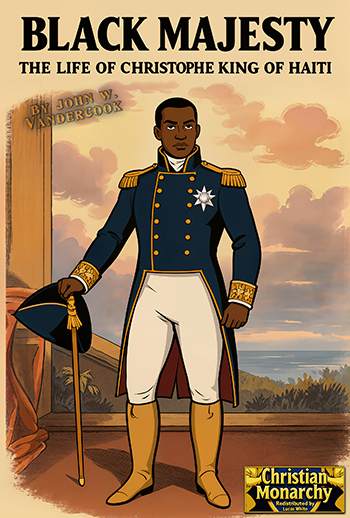
LeClerc was delighted with Christophe's reply. But LeClerc was young. His defeats and the loss of more than half his army had failed to impress upon him the caliber of the black fighters in the hills.
He wrote Christophe:
Think of the essential service you could render the Republic by furnishing the means to secure the person of General Toussaint.
He showed General Christophe's answer to Pauline. They laughed together over it. The nigger stable-boy was proud indeed! The secretary who had penned the answer spelled queerly and Christophe's locutions were a trifle awkward. Such splendid words! "It would be perfidy and treason! A proposition so degrading to me is, in my opinion, a mark of your invincible repugnance to believe me susceptible of the smallest sentiment of delicacy and honor. Toussaint is my commander and my friend. Is friendship, Citizen-General, compatible with such baseness?"
Christophe proved coy, but LeClerc longed for victorious news to send to the impatient politicians in Paris. At Christophe's insistence he drew up and submitted to him a full law code for the governance of Saint Domingue which unequivocally guaranteed freedom to the blacks. He agreed to grant complete amnesty to all the rebels. He promised that Christophe would be sustained in his rank of General of Brigade and provided with an appropriate command in the French army.
The work of rebuilding Cap Francois had proceeded astonishingly. The town had recaptured some of its old gayety. Pauline's salons at her palace on the promontory were no longer marred by universal gloom.
When Christophe rode down from the mountains at the head of his tiny company the townsfolk were in a mood to do him honor.
Mulatto and negro women met him far outside the town gate. They were his neighbors and his friends. Some had known him as a waiter at the Crown Hotel. All had known him as governor of the city. His order, it was true, had set flame to their homes, but the tall young negro who rode so erect on his white horse at the head of the ragged regiment was their own. The long-fingered brown hands that lay relaxed on the white mane of the horse were negro hands that had gestured gorgeously before the face of Europe.
The streets of Cap Francois were bedecked with palm fronds, twigs of scarlet poinsettia and waving branches of bourgainvillea vine. Arches wound with flowers had been erected over street crossings. The little procession rode through a long channel lined at either side with French soldiers in parade uniform. At a signal every gun on every ship of the fleet in the harbor fired a salute. Captain-General LeClerc and his officers received Christophe in state on the broad terrace of Pauline's palace.
A few days later Toussaint, a broken, tired old man, rode into the city at the head of a few bedraggled regiments. His reception almost exceeded that awarded Henry Christophe. Dessalines followed. He, too, was received with honor.
But the high commanders of the French were angry and troubled to observe that when they received Dessalines, not once in a long interview did he look them in the eyes. He kept his head averted and his broad back turned rudely toward them. Dessalines long ago had sworn an oath that he would never look into a white man's face.
Christophe and Dessalines were installed in their new capacities as French generals. Toussaint L'Ouverture, his life-long ambition for the freedom of the blacks realized at last, voluntarily divested himself of all offices and honors, and retired to a small plantation in the arid plains near the city of Gonaives, a port on the eastern rim of the bay.
Word went round the world that Napoleon's invincible armies had achieved another conquest.
LeClerc, before the surrender of Toussaint, had written him:
You, General, and your troops will be employed and treated like the rest of my army. With regard to yourself, you desire repose and you deserve it. After a man has sustained for several years the burden of the government of Saint Domingue, I apprehend he needs repose! I leave you at liberty to retire to your estates as you please. I rely so much on the attachment you bear to the colony of Saint Domingue as to believe you will employ the moments of leisure you may have in your retreat in communicating to me your sentiments respecting the means proper to be taken to cause commerce and agriculture to flourish once more,
One month later the frigate Créole was secretly dispatched from the Cap. Under cover of darkness she stood into Gonave Bay and let her anchor fall.
Toussaint had been invited to the home of a French general named Brunet to discuss with him certain points relating to the disposal of troops. He was received with courtesy and shown to a private room overlooking a balcony, to dress for dinner. In a moment a squad of soldiers with drawn swords entered through his window. The suddenness of their appearance dazed him. Then the realization swept over him that, lured by protestations of friendship, he had been led into a trap. In spite of their vaunted "words of honor" the French had come to take him. With a saber point against his heart the old warrior relinquished his sword—the sword that had not left his side in ten years of triumphs. He was carried with all haste and secrecy by back roads down to Gonaives.
Toussaint was put aboard the Créole and it sailed to Cap Francois. In the harbor he was transferred in a small boat to the warship Héro. His wife and three sons, who also had been arrested, were put aboard with him. LeClerc hastily signed the Héro's sailing orders. She lifted her sails, caught the morning wind, and set her course for France. A few idlers, ignorant of her great cargo, for the news of Toussaint's arrest had been carefully kept secret, watched from the waterside of Cap Francois.
Toussaint, "The Opener," stood on the decks, his rakish cockade hat with embroidered gold braid on it held under a trembling arm. He saw the hills of his beloved island slip down over the world's rim forever.
Toussaint was ugly. He was small in stature, and slender with the frailty of sixty weary years. His narrow forehead was ridiculously high, his teeth were prominent. His bulging eyes stared from a brown face puckered in a lacework of fine wrinkles. Tears coursed down his cheeks. He turned to a French officer who stood beside him.
"In taking me away from my country, monsieur," he said, "you have cut down the trunk of the tree of black liberty in San Domingue. That tree will bloom again, for its roots are deep and strong." He bowed and went below to his cabin.
On the arrival of the Héro in Brest, Toussaint was permitted a hurried parting with his wife and three sons. Then he was taken and imprisoned in the Temple in Paris. After a little time he was transferred to the Fort de Joux, near Pontarlier, in the Jura Mountains.
He was never tried for any crime. He wrote many letters to Napoleon in which he besought at least the justice granted a common felon—if the savior of France's richest colony from her Spanish and English enemies did not, in their estimation, merit more. But Napoleon never answered, though several times he sent one of his aides to visit Toussaint in his dungeon to try to bully him into telling just where he had hidden a suppositious treasure of $40,000,000.
The aide found out nothing, for Toussaint would only shake his head dully and ask over and over again what had been done with his wife and his children. He never learned.
Toussaint had never in his life been beyond the eternal warmth of the tropics, but he survived one winter in a stone dungeon in the Alps. Then, in the spring, on the night of Wednesday the 27th of April, 1803, he died. No one had ever brought him news of what transpired in Saint Domingue. He went to sleep with a dream in his heart of crooning negro voices on the summer hillsides of an island far away. In the morning they found him curled up like a child on his pallet bed. The sweat of the walls had dripped down and puddled coldly on the floor. They had taken from him even the ragged remnants of the dress uniform of the Governor-General of Saint Domingue.
Napoleon had conquered.
LeClerc was young.
The old man had frightened him.
During the month which Toussaint had spent as a private citizen on his farm near Gonaives, LeClerc's men had "intercepted" two letters the "First of the Blacks" had written. Both might have been construed as innocent—but the young Captain-General thought not. They hinted, he fancied, at a renewal of rebellion. In one Toussaint said, "Providence may come at last to our assistance." . . . Providence was the name of the military hospital of Cap Francois. It was filling rapidly with dying Frenchmen. Yellow fever had begun.
LeClerc, immediately on the departure of Toussaint, gave an order for the disarming of the peasants. Six years before Sonthonax, the French Republican Commissioner, had distributed 20,000 rifles to the newly liberated slaves, saying: "Here is your liberty. Whoever tries to take these guns away will make you slaves again."
Christophe and Dessalines were intrusted with the delicate task. With their customary energy they disappeared into the mountains and hidden valleys of the north.
Saint Domingue was sweltering in the terrific, humid heat of an exceptional summer. The white European officers and men wanted nothing except to rest as quietly as might be near the seacoast, and were glad to leave the thankless business to the blacks. Christophe and Dessalines seemed faithful.
It amused the gentlemen of the high command to think how cheaply they had been bought—two bright new uniforms, two high commissions in the army of France, and those black rebels had been converted to devoted friends. It was just as he had told them, General Rochambeau remarked. He had been a planter in Saint Domingue before freedom had ever been heard of, so naturally he "understood niggers."
There was no doubt about it. In spite of the violent and often bloody protest of the peasants, Christophe was disarming them as fast as he could reach new districts. Several forts in the interior were overflowing with confiscated guns, he said in his reports. He had neither time nor men to spare for bringing them down to Cap Francois. "But I have them safe."
No echo of the young giant's laughter came down to the sea.