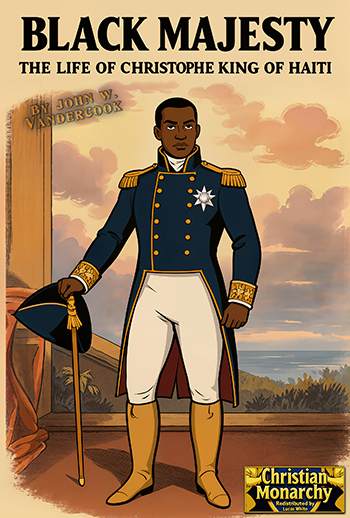
The Thursday courts had another purpose. Plantations had been assigned by the state to all the nobles, and the King had hit upon a plan designed to make those plantations fruitful. Though most of the new negro aristocrats despised the rigid formality of the Thursday levees, they without exception adored the dignity of titles and the magnificence of their court costumes. These Christophe, who had deliberately planned cause and effect, changed at frequent intervals, and each season's official order prescribed richer materials and more costly swords and ornaments. The dukes and counts and barons, because they had no other source of income, therefore brought their lands by dint of continuous individual activity to the peak of productiveness. A tailor's bill had to be paid, and it was one thing above all others worth paying. Even negroes who could never quite break themselves of the life-long habit of sleeping on the floor, who honestly preferred boiled plantain and white rum to grouse and old champagne, agreed to that.
Under the King's strict rule the land was everywhere yielding again. By his orders, expressed in the Code Henry, every adult man and woman in the kingdom was required to work. "The following hours of labor are irrevocably established," read the Code. "From daylight to eight o'clock, then one hour off for breakfast on the spot; from nine to twelve, then two hours off, and from two p.m. until night fall."
The Code Henry, however, though it was rapidly making Haiti prosperous, had delicate explosive in it, especially since just over the border in Pétion's republic universal idleness was both permitted and practiced. Christophe knew this. But he had resolved to build, no matter how many bricks were cracked.
The cultivators, under the Code, were bound to the soil. But "no landlord has authority to eject any cultivator from his habitation on pretext of illness or infirmity," it said. Hospital and medical attendance was furnished for all workers at the expense of the landlord, and no landlord, even though he was a prince of the realm or the King himself, could change his residence or fail to keep every inch of tillable soil in continuous cultivation. Landlords were required to support the "aged and infirm." They were forbidden to transfer a worker from one branch of activity to another against his wish. Soon they had bitter reason to know that cruelty or neglect of their peasants resulted in swift demotion down to the rank of common laborers.
"Slavery!" the indolent muttered. "Slavery!" shrieked the corrupt politicians in the Republic of the south. But peasants and landlords alike kept the full value of their produce, for Christophe's Kingdom quickly became self-supporting.
As the warm perpetual summers slipped by, Haiti became rich. The insatiable energy of the King put a small merchant marine afloat. His letters brought experts from England who built and equipped a weaving mill in Cap Henry which was quickly so successful that Haiti entirely ceased importing cotton cloth.
Christophe monopolized the meat supply and became the chief butcher of his kingdom. The cattle grazed on state lands and the revenue went into the state coffers. In all business deals Haiti bought with produce and sold for gold.
Christophe was himself the greatest builder and the greatest planter in his kingdom. Sans Souci before long was one of seven only slightly less gorgeous royal palaces. Besides these, as time advanced, he erected fifteen chateaux. Each was in a different part of the kingdom and each was surrounded by wide and fertile lands that were continuously planted and continuously reaped.
From the leaded windows of Henry's bedchamber at Sans Souci he could see several of his smaller mansions in the midst of mile upon mile of rustling cane fields. In one year his plantations had produced 10,000,000 pounds of sugar, two-thirds of the kingdom's total export of that commodity. Under the stimulus of the work laws the port of Cap Henry alone had, in a single year, besides sugar, exported 20,000,000 pounds of coffee, 5,000,000 pounds of cacao, 4,000,000 of cotton, and a quantity of logwood, fruit, and other minor country products.
England was in a radiant mood at being the handler of such magnificent trade and she triply enjoyed it because it profoundly irritated the French. Out of gratitude, she made Christophe the fashion.
Clarkson and Wilberforce, just then busied in bringing England to declare for the universal abolition of black slavery, entered into correspondence with Christophe, gave him much useless advice, and quoted his career as a proof of what negroes could attain to. More and more Englishmen came to settle in Haiti. A handsome clubhouse for their use was built from the shell of an old plantation manse outside of Cap Henry at the limit of the coastal strip beyond which no Europeans were permitted to go without special permission of the King. And the Foreign Office, moved by overwhelming curiosity, suggested that Sir Home Riggs Popham, commander-in-chief of the West Indian fleet, call at Haiti and then write his impressions.
Sir Home Popham's fleet had rested in the harbor of Cap Henry several times. The Cap lay on the way to Jamaica, where the Admiral made his base. It was a convenient shelter during the hurricane months, and an occasional visit of full-rigged men-of-war put heart in the Britons who bought coffee beans and sold Birmingham iron pots in the whitewashed stores in Henry's still half-ruined capital.
The sailors from the ships frequently came ashore. On one particular night certain seamen felt they had had enough of the meager adventures the port afforded, and at about ten o'clock, their elbows interlocked for support, they reeled down to a shore-front jetty where their boat was moored. One carried a bulging burlap sack. A negro sentry, almost invisible in the pale starlight, stood on the pier. He challenged the Englishmen and told them they must show him the contents of the sack. Nothing, he explained, could leave the port without customs inspection, and in the absence of proper officials he, the sentry, was the customs.
With thoroughness and nautical emphasis the sailors cursed him for a damned black bastard and explained that as seamen of His Majesty they could go and come as they pleased, taking any number of burlap sacks with them. The sentry, who understood as little English as they did Creole, remonstrated, so they knocked him neatly off the end of the jetty into the dirty shallows of the bay. A crowd of negroes appeared out of the shadows and in another moment a young British officer who happened by had drawn his sword and was challenging the world.
King Henry was in the city that night at a ball. A messenger who was sent for him explained that the quarrel was rapidly spreading to the proportion of a riot and begged the King to come. Christophe, who was wearing a uniform of white satin trimmed with gold, hurried down to the beach.
The crowd of negroes fell back silent, leaving the now partly sobered Englishmen standing in a defiant group. The black monarch walked close to them. They were men of average size, but Christophe towered above them. They realized with scorn they were in the presence of the "nigger" King, but they likewise realized they were in the presence of a man who, though middle-aged, could readily take any three of them and crack their fuddled heads together.
The enraged and dripping sentry explained. Before he was done the English officer, a young lieutenant, gave an angry order to his men and started down the jetty steps to the boat. Christophe reached out and took him by the slack of his coat just under the chin and lifted him ignominiously off the ground. Then, with the Briton's apoplectic and startled face a few inches from his own, he said to him in a tone of aggravating calm: "My soldier is right. The laws of the port forbid taking goods off without examination. But in obeying the letter he forgot that drunken children will not likely have anything of value. Go back to your ship, and if we have no further trouble I will not report you to your superior." With a slow smile and an uncomfortably sudden jerk Christophe let the officer's kicking feet touch the earth. He turned about, and as he walked away through the darkness he found it wise not to hear the curses which the white men, now safe a few yards offshore in their rowboat, bellowed after him.
The story was carried to Sir Home Popham. The next morning he asked for an official audience at Sans Souci.
A painted royal carriage drawn by four gray horses came down to the port for him, and with courteous young Dupuy as escort he was driven for two hours along the wide, stone-paved royal road that ran straight from the gate of Cap Henry to the palace. With growing wonder and admiration Sir Home listened to Dupuy's informed talk of politics and books and personalities, and watched the panorama of cultivated fields run by on either side. And at the end of the drive Dupuy conducted him up the grand staircase to where King Henry, surrounded by the high officials of the court, awaited him on the terrace.
The Admiral, a tall, distinguished Englishman, wore his full-dress uniform, but he found himself eclipsed by the splendor of Henry and his courtiers. Painfully he realized that the afternoon was hot and his broadcloth more appropriate to the bleak chambers of Windsor than to the verdant terraces of Sans Souci. Had he not been a gentleman, Sir Home would have been very uncomfortable indeed.
Christophe stepped forward, shook hands, and greeted him with courtly propriety. Sir Home had turned the matter over and over in his mind without reaching a decision, but the phrase he had debated came naturally to his lips. "I am honored, Your Majesty," he said, and bowed.
Dupuy introduced Sir Home Popham to the others. With a sense of increasing ease he shook hands with Count Prévost, with Vastey, with Duke Richard of Marmelade, and with Moor and Dr. Stewart. Then they all went into the library and tea was served.
It was the first official visit Christophe had received from a foreign power, and he had given elaborate orders pertaining to the formalities which were to be observed. It was vital that England, Haiti's best customer and most valued friend, be impressed through her envoy. But that night, after a state banquet at which Sir Home drank vintage champagne from golden goblets and wiped his lips with a damask napkin embroidered with the coat of arms of Haiti, he found himself on a moonlit balcony outside a lighted window, leaning his chair against the palace wall. Unconsciously he unbuttoned his tight jacket at the collar. Christophe was at his left and near them were seated Dupuy and Moor and Dr. Stewart.
For some time Moor and Stewart and Christophe had made it a custom to sit together each evening at the same place on the terrace. The two white men would take turn about reading to their king, their chairs tilted back against the palace wall so that the light from the window fell on the pages in their hands. Moor was an amateur specialist in world politics. The leading journals and the official documents of England and France came to him and it was his duty to go carefully through them and read aloud the more important and relevant passages. Christophe, his black forehead wrinkled with attention, used to interrupt when words and references cropped up which he did not understand, and both friends would explain. Dr. Stewart performed a similar service in the realm of literature. The best books, essays, verse, and fiction, published currently in London and Paris came under his scholarly eyes, and he read the things he judged best to the King—who fought against ten thousand years to understand.
"Your Majesty," said the Admiral, "if you will pardon my saying so, that was uncommonly fine duck."
Christophe, in the shadows, answered, "It is a special cross I have bred for the table, part common duck and part Muscovy. I shall send a brace to your ship tomorrow."
Dr. Stewart chuckled. "Henry, Sir Home, finds time for everything."
They sat there until the lights in the windows of Sans Souci went out one by one and the full moon rose high into the iron blue dome of night.
Sir Home had recently visited Port au Prince and talked with Pétion. Henry pumped him for detailed news.
The republic, thanks to Pétion's corrupt officials and his worthless tin currency, was close on bankruptcy, it seemed, but Sir Home insisted that its strength was not to be underestimated.
"Your work laws," he told Christophe, "are unwise. In the south they say your subjects are no better than slaves and that you are a second Dessalines. You are going too fast. Pétion has an army and if you ever stumble he will be over the border and at you, and every man and woman in Haiti who confuses idleness and independence will join him. . . . Sorry. I don't know why I fancy I am privileged to advise you." The Admiral coughed apologetically.
For a long moment Christophe was silent. The others peered at him intently through the half dark. When he spoke his full rich voice seemed suddenly old.
"You do not understand. . . ." He stopped again, seemed to be struggling for words. Then he went on:
"My race is as old as yours. In Africa, they tell me, there are as many blacks as there are white men in Europe. In Saint Domingue, before we drove the French out, there were a hundred negroes to every master. But we were your slaves. Except in Haiti, nowhere in the world have we resisted you. We have suffered, we have grown dull, and, like cattle under a whip, we have obeyed. Why? Because, m'sieu, we have no pride! And we have no pride because we have nothing to remember. Listen!" He lifted his hand.
From somewhere behind them was coming a faint sound of drumming, a monotonous, weird melody that seemed to be born of the heart of the dark, rearing hills, that rose and fell and ran in pallid echoes under the moon.
The King went on. "It is a drum, Sir Home. Somewhere my people are dancing. It is almost all we have. The drum, laughter, love for one another, and our share of courage. But we have nothing white men can understand. You despise our dreams and kill the snakes and break the little sticks you think are our gods. Perhaps if we had something we could show you, if we had something we could show ourselves, you would respect us and we might respect ourselves.
"If we had even the names of our great men! If we could lay our hands"—he thrust his out—"on things we've made, monuments and towers and palaces, we might find our strength, gentlemen. While I live I shall try to build that pride we need, and build in terms white men as well as black can understand! I am thinking of the future, m'sieu, not of now. I will teach pride if my teaching breaks every back in my kingdom!"
His voice at the last had risen to a subdued roar of passion. When he had done, he stood up so suddenly his chair clattered noisily on the stone flags. He strode away from them down the terrace and went out of their sight through a doorway into his palace.
In a few minutes Dupuy retired. The three Englishmen—the Admiral, the physician, and the mathematician—sat talking until the sky grew gray with the approach of dawn.
Early the next afternoon King Henry invited Sir Home Popham to witness a review of his household troops. A rich carpet was laid on the main terrace under the shade of a tall star-apple tree. Chairs were arranged, and the King, the Queen, the Admiral and numerous mulatto and negro officials took their places. At a nod from Henry a bugler blew a call and from around a wall at the left came a company of soldiers, marching eight abreast.
The Admiral gasped. Every man in the procession was at least six feet tall, all were full-blooded negroes, they wore elaborate and splendid uniforms, and they marched, the trained eyes of the Englishman noted, with a marvelous precision. Their polished muskets were all at the same angle, and every booted foot swung in time. Each company wheeled, presented arms, and after it passed the reviewing place disappeared from view down the grand stairway.
As each regiment appeared Sir Home was treated to the spectacle of a different but hardly less striking uniform.
The afternoon advanced, but the endless, unbroken procession still continued. Sir Home Popham, dazed and marveling, estimated that not less than 30,000 men had passed before them.
At twilight the King asked the Admiral if he had seen enough, and Sir Home wearily assented. Christophe gave an order and the last file of men marched down the stairs.
As they went indoors, Christophe asked the Admiral if Pétion could boast any such display of men, and Sir Home, with vigorous emphasis, shook his head.
He did not know that an important detail of the review had been concealed from him—that as each squad passed from sight the men broke ranks, turned off when halfway down the grand stairway, and filing through a concealed opening in the wall, hurried by an underground passage to the barracks behind Sans Souci, and that there they changed their uniforms and fell into ranks to pass in new guise before the throne again. Christophe had taken advantage of the European notion that all negroes look alike and had treated him to thirty views of the same one thousand men.