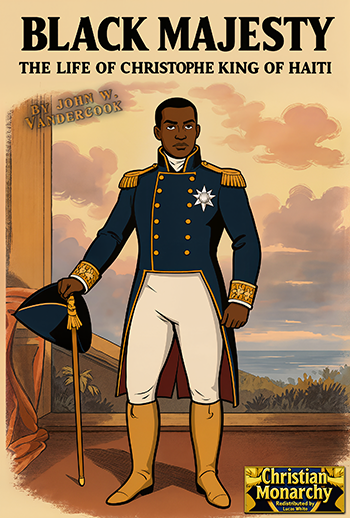
When Christophe became chief governor in 1807 the mulattoes, who filled the upper stratum of Haitian society, had expected him to grant them special favors. Many claimed large tracts of plantation land as their hereditary property—hereditary because the mulattoes making the claim were the bastard children and grandchildren of the Frenchmen who had formerly held the land. Henry had been so ungracious as to laugh at them. That had reopened an old wound.
After his last military expedition against Port au Prince, he had returned to discover that in his absence the leading mulatto women of the Cap had held a special service in a church to pray to the Virgin for his defeat and death. On that occasion Henry had not seen fit to be amused. In a fury he had sent soldiers into the city at night to find and kill the women most conspicuous in the treason.
After he became king, tranquillity still eluded him. Scarcely a month had passed without the discovery of some plot against him somewhere in the kingdom, and without exception mulattoes were most deeply concerned. So far, the King had always found them out and always meted vigorous punishment, either death by the sword of Gaffie, the black executioner—who was so skilful he claimed he could take a head off without soiling the adjacent collar—or hard labor on the ever-mounting walls of the Citadel.
Once the French priest, Corneille Brelle, discovered a highly organized and widespread conspiracy among secret adherents of Pétion who lived in the Kingdom. They hoped to murder the King and hand the country over to the Republic. For that the conspirators were executed.
On another occasion some rich young mulatto men formed a poetry club at Cap Henry and called it Le Petit Vers—a seemingly innocent enough business. But it happened that in the King's garden grew a special kind of coffee tree whose berries, known at Sans Souci as Les Petits Verts, were reserved for the royal table. Christophe suspected a mocking pun and the poets were sent to work on the fortress walls. The educated Haitians had always found vast amusement in an ex-slave's pretensions to Epicureanism.
After less than half a year in Haiti the two ladies from Philadelphia went home. "We take with us only the pleasantest recollections," they said, and courtsied to the King. He himself drove them down to Cap Henry and saw them off.
Christophe had gone too fast, and because his people did not share his ambition and his energy he grew savagely impatient. Soon no one felt safe from his furies.
Duke Richard, governor of Cap Henry, and chief aide-de-camp of the King's military household, was a man of great authority in Haiti. No one below the King had a more devoted personal following among the soldiery than he. But once Christophe found him sprawled asleep in the grand salon at Sans Souci and noted that his uniform was wrinkled and disarranged. He took Duke Richard by the throat and shook him as a terrior shakes a rat. No one must let down. The work was not yet finished. Pride, dignity—these had become obsessions of the King.
Soon afterward Henry learned that Richard had again relaxed. He had again been careless and again shown indolence, this time in carrying out an important matter of state business. For that Henry sent him to work for three months on the walls of the Citadel in company with common criminals.
Once Christophe, standing on the walls of the Citadel, looked through his telescope and saw a negro farmer more than a mile away in a valley far below him, lying sound asleep by the door of his mud-walled cottage. The King knew the man. Twice before he had reprimanded him for idling during the stipulated hours for work. His lips drew back from his teeth in a snarl of sudden, senseless rage. He called for a captain of artillery and together they went into the cool, long gallery where the huge bronze cannon were ranged behind their little windows in the wall. The young captain, obedient but trembling, took aim, while Christophe grunted with the labor of dragging on the ropes that turned the heavy gun carriage. It was ready loaded. Henry lit the fuse and the morning quiet was shattered with the reverberant, resounding roar of the explosion. But the man asleep in the sun did not hear. The hurtling cannon ball, superbly aimed, smashed him and his mud hut together.
There was no doubt that he had changed. His enemies said that he was drunk at last and dangerous with too much power. Even his friends wondered if now that more than half the century of life was behind he had not, with weariness and age, slipped back into sullen savagery, a stain that perhaps old ugly Africa had put on him.
Sir Home Popham, the English Admiral, had come often to Sans Souci. In the summer of 1820 he came to say good-by. His health had broken and he was going home to England. They were both old—or so they thought themselves—and perhaps they would not meet again.
In the heat and silence of a week-day afternoon they climbed the hill together. The boy with the telescope followed at a distance. They found a shaded rock from which one commanded a view of the Plaine du Nord and the white houses of Cap Henry twenty miles away. The lean, distinguished British sailor and the giant negro sovereign sat down and mopped the perspiration from their foreheads. For a few moments they were silent. The King's huge frame was curiously relaxed. He had grown heavier lately and little furrows ran out from the corners of his eyes.
"They tell me, Henry," said the Admiral at last, "that you have turned tyrant. Why?"
Christophe's hands opened in a queer gesture of helplessness. His head bent down and for a moment he looked unseeing out toward the faraway sea. He spoke with measured, dull precision.
"Maybe I know no other way. Sometimes a fury comes over me and there is a foul taste in my mouth. I am blind with anger . . . . Last night I learned that my chaplain Corneille Brelle was in correspondence with men in the south. Why? I don't know. Perhaps because he could never tame me for his church. More likely because I would not compel the peasants in the hills to kill their snakes, their poor little gods, or break their drums. Brelle calls them damned. . . . His reasons do not matter. Letters were found under his cassock, and that is enough. He has already told them in Port au Prince how many soldiers I have and how many guns. He will lose his head at dawn to-morrow. That is what you call tyranny?"
He drew in his breath sibilantly and his voice took on more volume and a new richness.
"I know no other way. No man hates waste more than I do. I am angry if I see red coffee berries rotting neglected on a tree. The lives of men are precious, too. Each time I must condemn a man to die it wrenches me, perhaps a little more, perhaps a little less. . . . But, Sir Home, though I am King, though they call me Majesty, you must remember I am still an ignorant old man. I cannot read. What other men have thought and done is no help to me, except what I learn of them through my friends. . . . When I took an army to Port au Prince after they had killed Dessalines, I frightened them so badly I lost half my kingdom. 'Christophe,' they say, 'is stupid. All he understands is war and work. All he wants is a fortress and power. He is no politician.' Perhaps all that is true. But in the time that remains to me I must do what I wish as I will. I have many enemies, I know. There is not a plot against me I don't know of. Some of the fine fellows down there," he pointed to the red roof of Sans Souci below them, "would be frightened if they knew how much I know! But do you see these?"
Two great clenched fists were thrust out and his eyes sought the Admiral's face. "My courtiers tell me I am king because of my brains, because I know so much. That is nonsense! I am king because of these! So long as they are strong I will have a thousand friends to every enemy. Even my friends don't love me, but if they obey me that is enough. When death opens this fist the work will be done. Haiti will be great, strong, rich, proud—so proud it will last forever! Then the blacks will not forget the name of Christophe."
The King rose to his feet and held his hands out before him in a strange ecstasy. His eyes were bright, and his lips stiff with the intensity of his mood.
"Come now, if you are rested. I have a commission which I would be obliged if you would fulfill for me in London."
That night Sir Home Popham took aboard his flagship a heavy iron chest sealed with the royal seal. It contained $6,000,000 in gold to be deposited in the Bank of England in the name of Marie-Louise Christophe.
At dawn Gaffe, the executioner, struck off the head of the French priest, Corneille Brelle. He died pronouncing a curse on the name Christophe.
Henry was absent all that day from Sans Souci. In the late afternoon, as had become his invariable habit, he climbed the steep trail that led to the fortress on the mountain peak. Once there he granted only a curt nod to the officers of the Citadel garrison and went into his private chamber. A sentry outside the door heard the clicking of billiard balls. A table had been carried up the mountain, a task that took many men days, and was installed in a high-domed room that gave on a wide terrace from which one commanded a view of a third of the kingdom. When Christophe was a waiter he had marked the shots of French planters who lounged at the Crown Hotel. When he became King, billiards was his favorite diversion. Usually he played with officers and courtiers, but this afternoon he played alone.
After a little, as the twilight mists were scudding up from the sea and breaking softly against the great prow of the fortress, he came out dressed in a dusty ragged coat, torn knee breeches and a pair of battered boots.
The workmen were just coming down from the walls. He took a mason's trowel from a black prisoner and mounted a ladder to a point on the highest rampart.
The soldiers of the garrison, the prisoners, and the conscript peasant laborers ate their evening rice and plantains around little fires in the parade ground. That night they talked in whispers and kept their eyes turned up to where the lonely figure of their King was silhouetted, a tiny mark against the luminous night sky. The regular click-slap, click-slap of his trowel throwing mortar and tapping the big flat bricks came faintly down to them. Often in recent months he had worked at his old trade of mason on the walls of La Ferrière. Several times he had worked till daybreak and boasted that he, unaided, had done as much in a night as they had accomplished in a day.
The peasants whispered that on these lonely vigils he buried golden treasure.
In the great sections of the walls he raised there was ample room, they reasoned, for banded iron chests containing millions upon millions of American and English coins. . . . It was common knowledge that in the great vaults under the lowest dungeons there was a national treasure in gold that amounted to approximately $30,000,000. And, it was argued, if Henry could collect that much for the purpose of purchasing the San Domingan section of the island from Spain—a deal that was in an advanced stage of negotiation—how much, then, would he not be apt to set aside for himself?
In the hundred years the Citadel's been empty, many men have gouged great holes in its massive walls seeking for what Christophe hid. But their failure to find anything lends credence to the claim advanced then by Henry's friends—that he labored on the walls for the selfsame reason that he bullied Duke Richard and sent so many to their death—because he was fired with a giant impatience; because in the year 1820 the King was ridden by a sense of haste that tortured him.